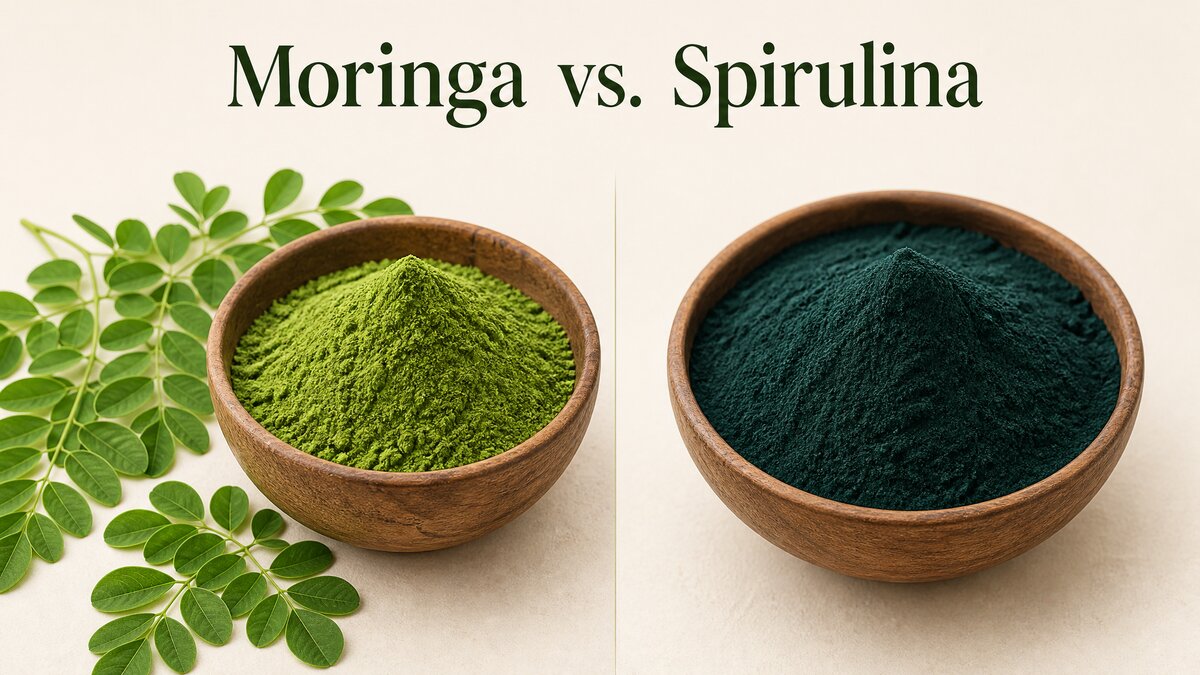
A Plant and an Algae, Both Called "Superfoods"
Moringa and spirulina are frequently mentioned in the same breath — both are green, both are sold as powders or supplements, and both carry the "superfood" label. But they come from entirely different biological kingdoms, which matters more than most comparisons acknowledge.
This article is for the specific question "which of these two should I take, and does the protein difference matter for me?" If you're comparing Moringa against superfoods more broadly, start with our hub: Moringa vs Other Superfoods: How to Compare Them Honestly.
What They Actually Are
Spirulina is a blue-green algae (cyanobacterium) that grows in warm, alkaline water. It's harvested, dried, and typically sold as a powder or in tablet form. It's one of the oldest life forms on Earth and has been consumed by various cultures for centuries.
Moringa is the leaf of a fast-growing tree, Moringa oleifera, native to the Indian subcontinent. It's a true land plant, harvested and dried much like any other leafy green.
This distinction — algae versus plant — shapes everything else about how they're produced, what they contain, and how they're best used.
Protein Content: Spirulina's Signature Strength
This is where spirulina genuinely stands out. USDA FoodData Central lists dried spirulina at roughly 57 g of protein per 100 g [1] — exceptionally concentrated for a whole food. (You will often see "60–70%" quoted; the real figure varies with strain and growing conditions, and 57–65% is the range supported by reference data rather than marketing copy.) Spirulina is a complete protein containing all essential amino acids, which is part of why it's popular among plant-based athletes.
Dried Moringa leaf powder sits around 25–30 g of protein per 100 g [2], and contains all nine essential amino acids — notable for a leaf, but a materially lower concentration than spirulina.
If protein density is the primary goal, spirulina has a clear edge. We're not going to argue that one.
One caveat that applies to both: at a realistic 5-gram serving, neither is a meaningful protein source. Five grams of spirulina delivers under 3 g of protein. These are micronutrient contributions with some protein attached, not protein supplements.
Nutrient Profile Differences
Spirulina's strengths: Extremely high protein density, phycocyanin (a unique blue-green pigment with antioxidant properties not found in moringa), and notable B-vitamin content, including B12 in some forms — though the B12 in spirulina is debated in the research community regarding how usable it actually is by the human body.
Moringa's strengths: A broad vitamin and mineral profile including iron, calcium, provitamin A and vitamin C, plus flavonoids (quercetin, kaempferol), phenolic acids and isothiocyanates rather than spirulina's phycocyanin [2]. Moringa also offers the full plant — leaves, pods and seeds — each with a different composition, whereas spirulina is consumed as the whole organism in a more singular form.
Where the human evidence differs
This is the part most comparisons skip. On one specific outcome, spirulina has the better research: meta-analyses of randomised controlled trials report improvements in blood lipid measures with spirulina supplementation [3][4]. Moringa does not currently have evidence of that quality behind an equivalent claim — a 2025 umbrella review of Moringa research concluded that while the literature is broad, the methodological quality of the underlying reviews is generally low [5].
Broader nutrient profile does not equal better-proven. Both things can be true at once, and here they are.
Taste and Practical Use
Spirulina has a strong, distinctly "oceanic" or algae-like flavor that many people find difficult to consume on its own — it's most commonly taken in capsule form for this reason, or heavily disguised in smoothies.
Moringa has a comparatively mild, earthy, slightly grassy flavor that's generally considered easier to incorporate into food and drink, including in flavored powders or stick-pack formats.
For anyone who has struggled with the taste of spirulina specifically, this is often the deciding factor in switching to or adding moringa.
Growing and Sourcing Considerations
Spirulina is grown in controlled aquatic environments — often large ponds or bioreactors — which means water quality and contamination control are critical safety factors. Reputable spirulina sourcing requires careful testing to rule out contamination from heavy metals or harmful algae blooms in poorly controlled growing conditions.
Moringa, as a land-grown tree crop, faces different sourcing considerations — soil quality, growing region, harvest timing, and post-harvest processing (such as shade-drying versus high-heat drying) are the primary quality factors rather than water-based contamination risks.
Both require careful sourcing. The risks are simply different in nature.
Which One Should You Choose?
Choose spirulina if: your primary goal is maximizing protein density from a small serving size, and you don't mind capsule form or a strong flavor.
Choose moringa if: you want a broader vitamin and mineral profile, an easier-to-incorporate flavor, and whole-plant nutrition rather than a concentrated algae source.
Use both if: you're building a comprehensive whole-food supplementation routine and want the combined benefit of spirulina's protein density and moringa's broader micronutrient profile.
The Bottom Line
Spirulina and moringa aren't really competing for the same job. Spirulina is a protein-dense algae with a unique antioxidant compound and a flavor most people need to mask. Moringa is a broader-spectrum, whole-plant nutritional source with an easier flavor profile and a different set of strengths.
Neither is objectively "better." They're different tools, and the right one depends on what you're actually trying to accomplish.
Scientific References
1. U.S. Department of Agriculture, Agricultural Research Service. FoodData Central: Seaweed, spirulina, dried (FDC ID 170495). Reference composition database. USDA FoodData Central
2. Leone A, Spada A, Battezzati A, et al. Cultivation, Genetic, Ethnopharmacology, Phytochemistry and Pharmacology of Moringa oleifera Leaves: An Overview. Int J Mol Sci. 2015;16(6):12791-12835. Compositional review. PubMed
3. The effect of Spirulina supplementation on lipid profile: GRADE-assessed systematic review and dose-response meta-analysis of data from randomized controlled trials. Pharmacol Res. 2023;193:106802. Meta-analysis of human RCTs. PubMed
4. Serban MC, et al. A systematic review and meta-analysis of the impact of Spirulina supplementation on plasma lipid concentrations. Clin Nutr. 2016;35(4):842-51. Meta-analysis of human RCTs. PubMed
5. Health effects of Moringa oleifera: an umbrella review of systematic reviews and meta-analyses. Front Pharmacol. 2025;16:1572337. Umbrella review. Frontiers
This article is for educational purposes only and does not constitute medical advice. Read more about [how we assess evidence](/editorial-standards).
About the Formulator
Vital 1 by CoLab was formulated by Joshua Plant, PhD, a biomedical scientist with a Harvard doctorate and over 13 years of expertise in botanical formulation and nutritional science. His work focused on whole-plant sourcing, evidence-based ingredient selection, and shade-dried processing to preserve the full spectrum of nutrients.
Learn more about Joshua Plant, PhD and the science behind Vital 1Looking for the Whole-Plant Option?
Vital 1 by CoLab uses whole-plant, India-sourced, shade-dried Moringa as its foundation, paired with a botanical blend designed for broad nutritional support — in a flavor designed to actually be enjoyable, not just tolerated.
Now available. Connect with a Wellness Guide to get started and unlock exclusive offers.
🎁 Connect with a Wellness Guide to unlock exclusive offers and member-only perks.
Get StartedWhere would you like to go from here?
No pressure — just a few ways to take the next step, whenever you're ready.
Explore the research
Dig into what the studies actually show about moringa across different areas of health.
Read the benefitsTry it yourselfMake it part of your day
See Vital 1 — whole-plant moringa with 8 supporting botanicals — and how to get started.
Discover Vital 1Share it forwardHelp others learn too
If moringa has helped you, there is a calm way to share it with others — on your terms.
Explore the path