The Paradox of Modern Eating
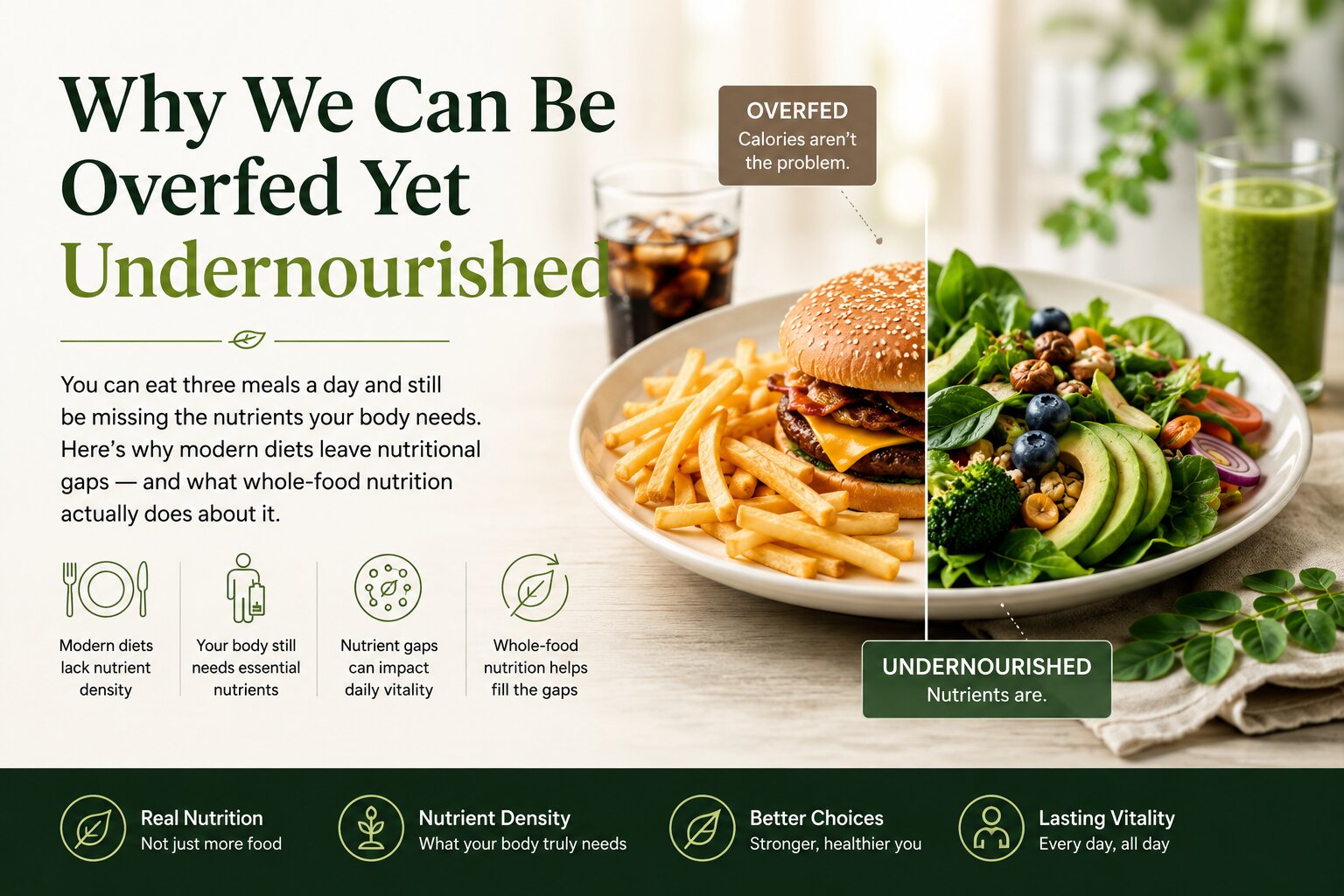
Most of us aren't starving. We eat regularly, often more than we need. And yet a growing body of research suggests that millions of people are nutritionally depleted — not from lack of food, but from a lack of the right nutrition inside that food.
The numbers bear this out. According to the USDA Economic Research Service (2024), 90% of Americans don't eat enough vegetables and 80% don't eat enough fruit — not occasionally, but routinely.[1] And data from the Linus Pauling Institute, drawing on NHANES surveys, shows the percentage of Americans falling below the estimated average requirement for key nutrients:[2]
| Nutrient | % Below Average Requirement |
|---|---|
| Fiber | 95% |
| Vitamin D | 95% |
| Magnesium | 61% |
| Vitamin A | 51% |
| Vitamin C | 43% |
| Calcium | 40% |
These aren't fringe numbers. They describe the nutritional baseline of the average American diet — and they explain why feeling "fine" and being well-nourished are often two very different things.
It sounds contradictory. How can someone eat three meals a day and still be missing what their body needs?
The answer has everything to do with what modern food is — and what it's quietly missing.
Calories Are Not the Same as Nutrition
Food gives us two things: energy (calories) and nutrition (vitamins, minerals, antioxidants, amino acids, phytonutrients).
Modern diets are remarkably good at delivering calories. Processed foods, refined carbohydrates, fast food — these are calorie-dense by design. They're engineered to be filling, satisfying, and convenient.
But they are frequently nutrition-poor.
You can eat 2,500 calories in a day and still fall significantly short of your body's requirements for iron, magnesium, B vitamins, Vitamin D, zinc, and dozens of other micronutrients that don't make headlines but quietly power everything from your immune system to your energy levels to your ability to think clearly.
This is the overfed-but-undernourished paradox. Full stomach. Depleted body. It is also the gap that nutrient-dense whole foods are best placed to close.
What Happens When Nutritional Gaps Go Unfilled
The body is remarkably adaptive. When it doesn't receive adequate nutrition, it prioritizes. It keeps your heart beating, your lungs breathing, your brain functioning at a basic level.
But it deprioritizes everything else.
Energy production slows. Recovery takes longer. Immunity becomes less robust. Hair thins. Sleep quality drops. Mood becomes harder to regulate. Concentration drifts.
None of these feel dramatic on their own. Each one is easy to explain away — stress, age, a bad week, not enough sleep. But when they cluster together and persist, they're often a signal that the body isn't getting what it needs to function at its best.
The absence of a disease is not the same as the presence of health.
Why Whole Foods Matter More Than Supplements
Here's where it gets important.
The instinct, when we recognize nutritional gaps, is to reach for a supplement. A multivitamin. An isolated vitamin C tablet. A zinc capsule. These have their place — but they work very differently from the nutrition found in whole foods and whole plants.
Nutrients in whole foods don't work in isolation. They work in relationship with each other. Vitamin C enhances iron absorption. Magnesium activates Vitamin D. Antioxidants work synergistically — meaning the combination of multiple antioxidants in a real plant is more effective than any single antioxidant extracted and concentrated on its own.
When you isolate a nutrient from its plant matrix and put it in a capsule, you often lose that synergy. You're getting the note, but not the chord.
Whole-food nutrition — eating the actual plant, in as close to its natural state as possible — delivers nutrients the way the body evolved to receive them. Together. In context. With the co-factors that help them actually work.
The Problem With Modern Produce
It's worth noting that even people who eat well — lots of vegetables, whole grains, lean proteins — can still face nutritional gaps. Why?
Several decades of research have documented declining nutrient density in commercially grown produce. Soil depletion, faster growing cycles, early harvesting for shipping, and storage time all reduce the nutritional content of food by the time it reaches your plate.
A tomato grown in depleted soil and picked before peak ripeness is not nutritionally equivalent to a tomato grown in rich soil and harvested at the right time.
Harvest timing matters enormously. Peak-nutrition plants are harvested at the precise moment when nutrient density is highest — not when logistics are most convenient.
This is one reason why the sourcing and harvesting practices behind any plant-based nutrition product matter as much as the plant itself.
Consistency: The Missing Piece
Even when we eat well, most of us are inconsistent. A great week of nutrition is followed by a travel week, a busy week, a stressful week. The body doesn't store most micronutrients in large reserves. It needs regular, ongoing supply.
Nutritional change is gradual. One great meal does something. One great week does more. But it's consistent daily nutrition — over 30, 60, 180 days — that produces meaningful, lasting change in how you feel and function.
This is why the most important nutritional habit isn't the perfect smoothie or the ideal meal plan. It's the one you actually do every single day.
The Takeaway
You can be eating regularly and still be running on empty nutritionally. Modern food systems make it easy to fill up without fueling up.
Closing those gaps requires two things: whole-food nutrition that delivers nutrients in context, and the consistency to support your body every day — not just when you're being careful.
That's a higher bar than a daily multivitamin. But it's the bar that actually produces results.
References
1. USDA Economic Research Service (2024). Dietary data showing that 90% of Americans do not meet vegetable recommendations and 80% do not meet fruit recommendations. USDA ERS
2. Linus Pauling Institute, Oregon State University. Micronutrient inadequacies based on NHANES data, showing the percentage of the U.S. population below the Estimated Average Requirement for key vitamins and minerals. Linus Pauling Institute
3. Davis DR, Epp MD, Riordan HD. Changes in USDA food composition data for 43 garden crops, 1950 to 1999. J Am Coll Nutr. 2004;23(6):669-682. Documents statistically reliable declines in protein, calcium, phosphorus, iron, riboflavin, and vitamin C in vegetables over the second half of the 20th century. PubMed
These references support the nutritional-gap claims in this article. For our full evidence-review methodology, see [how we assess evidence](/editorial-standards).
About the Formulator
Vital 1 by CoLab was formulated by Joshua Plant, PhD, a biomedical scientist with a Harvard doctorate and over 13 years of expertise in botanical formulation and nutritional science. His work focused on whole-plant sourcing, evidence-based ingredient selection, and shade-dried processing to preserve the full spectrum of nutrients.
Learn more about Joshua Plant, PhD and the science behind Vital 1This Is Why Vital 1 Was Formulated the Way It Was
Vital 1 by CoLab is a multi-plant nutrition supplement built on whole-food principles — not isolated nutrients. It uses Moringa harvested at peak nutrition, shade-dried to preserve what matters, sourced from India where growing conditions are ideal, and combined with a botanical blend chosen for nutritional synergy.
Now available. Connect with a Wellness Guide to get started and unlock exclusive offers.
🎁 Connect with a Wellness Guide to unlock exclusive offers and member-only perks.
Get StartedWhere would you like to go from here?
No pressure — just a few ways to take the next step, whenever you're ready.
Explore the research
Dig into what the studies actually show about moringa across different areas of health.
Read the benefitsTry it yourselfMake it part of your day
See Vital 1 — whole-plant moringa with 8 supporting botanicals — and how to get started.
Discover Vital 1Share it forwardHelp others learn too
If moringa has helped you, there is a calm way to share it with others — on your terms.
Explore the path