By the Powered By Moringa Editorial Team
A note before you read on: This article is educational only and is not medical advice. Pregnancy and breastfeeding are individual medical situations, and moringa — like any food or supplement — should be discussed with your doctor, midwife, or obstetrician before you add it to your routine, especially in any form beyond leaves used as food. Nothing in this article should be read as a recommendation to use moringa during pregnancy specifically.
Few moringa questions come up more often than this one: is it safe during pregnancy and breastfeeding? The honest answer is that it depends heavily on which part of the plant and which stage you're asking about — and the evidence for those two questions is not the same. Here's what the research actually shows, and where the real caution points are.
The First Distinction That Matters: Which Part of the Plant
Almost every reputable source on moringa safety starts with the same distinction, and it's the single most important thing to understand: the leaf is not the same as the root, bark, or flower.
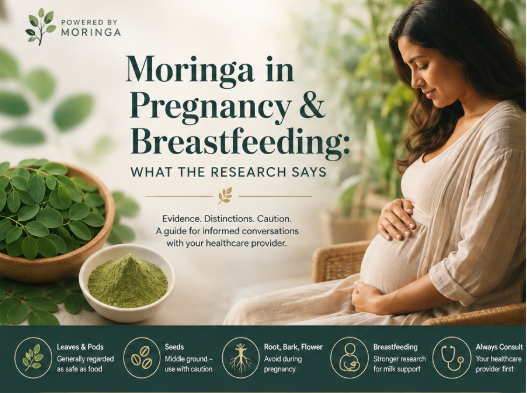
- Leaves and pods (the fruit), eaten as food, are generally regarded as safe during pregnancy and are the form used in essentially all of the research discussed below.
- Seeds sit in a middle category and deserve their own mention — they don't carry the same reputation for concern as root, bark, or flower, but they're not treated as cleanly as leaves and pods either. Some consumer health resources list seeds as likely safe when eaten as food. Others specifically advise against raw seeds in pregnancy, and at least one peer-reviewed animal study found that concentrated, lipid-rich seed extract was not safe at higher tested doses during pregnancy, while a lower-dose, lipid-free version of the same extract appeared safer. That's animal data, not a human safety verdict, but it's a real enough signal that seeds shouldn't be casually grouped in with leaf as "obviously fine."
- Root, bark, and flower preparations have a long history in traditional medicine as agents used to bring on menstruation, and they're reported to have uterine-stimulant effects. For that reason, health resources consistently advise avoiding these plant parts during pregnancy, particularly in the first trimester.
- Concentrated extracts, high-dose supplements, and strong teas made from anything other than leaf-as-food are generally the ones flagged for extra caution — the concern is potency and concentration, not moringa as a vegetable.
This distinction is why "is moringa safe in pregnancy" doesn't have a single yes-or-no answer. The vegetable on the plate and a concentrated root or seed extract are, from a safety standpoint, not really the same question. Our cornerstone guide breaks down which parts of the tree are used and why it matters.
What the Research Says About Breastfeeding
This is where the evidence base is strongest. Moringa leaf has a long-standing traditional reputation as a galactagogue — a substance used to support breast milk supply — particularly in the Philippines and South India, and this is one of the more heavily studied traditional uses of the plant in a clinical context.
A 2013 randomized, placebo-controlled trial of postpartum mothers found that while the difference in milk volume between groups didn't reach statistical significance by day three, mothers taking moringa leaf produced meaningfully more milk on average than the placebo group, and a majority of the moringa group met World Health Organization exclusive-breastfeeding benchmarks at six months. More recent systematic reviews pooling multiple randomized trials have reported that moringa leaf supplementation during the postpartum period was associated with measurable increases in both milk volume and prolactin (the hormone most directly tied to milk production).
It's worth being precise about what this evidence does and doesn't show:
- The studies are specifically about postpartum, breastfeeding mothers — not pregnant women.
- Study sizes are generally modest, and researchers themselves note the need for larger, longer trials to confirm optimal use and long-term safety.
- This is traditional-use evidence backed by a growing body of clinical research — not a guarantee of results for any individual.
What the Research Says About Pregnancy
This is the thinner and more contested area, and it's worth naming that plainly rather than rounding it up into false confidence.
Health Canada's own consumer guidance on moringa states plainly that it is not known how moringa may affect pregnancy or a developing fetus, and advises anyone who is pregnant or planning to become pregnant to tell their healthcare provider before use. That "we don't fully know yet" framing is the most accurate summary of where the science currently stands for supplement-level use.
At the same time, some observational research is more reassuring specifically about moringa leaf as food. A few regional studies have looked at moringa leaf consumption among pregnant women and reported associations with improved iron status and hemoglobin levels — relevant given how common anemia is in pregnancy — without flagging safety concerns in those specific study populations. That's a meaningfully different question from "is a concentrated supplement safe," and the two shouldn't be blended together.
Where caution consistently shows up across sources is, again, the root, bark, and flower — because of their traditional association with uterine stimulation — and, more broadly, with any high-dose or concentrated moringa product used without medical guidance during pregnancy.
Why "Consult Your Doctor" Isn't a Throwaway Line Here
This is one of the few moringa topics where that advice genuinely changes the answer. A healthcare provider can weigh moringa use against your specific pregnancy — first trimester versus third, any history of pregnancy complications, medications you're taking, and your individual nutritional needs — in a way a general article never can. If you're breastfeeding and curious about moringa as a traditional galactagogue, that's also a conversation worth having with your care provider or a lactation consultant, who can help you think through timing, form, and whether it fits your situation.
The Short Version
- Leaves and pods as food: the form almost all research is actually about, and the one most consistently treated as lower-risk.
- Seeds: a genuine middle case — not flagged as heavily as root or bark, but not as settled as leaf either, particularly raw or in concentrated form.
- Root, bark, flowers, and concentrated extracts: the forms most consistently flagged for caution in pregnancy.
- Breastfeeding: the stronger and more direct evidence base, specifically for leaf supplementation postpartum.
- Pregnancy: genuinely less settled — official guidance is honest that the full picture isn't known yet.
- In all cases: this is a conversation for your doctor, midwife, or obstetrician, not a decision to make from a blog post — including this one.
Sources & Further Reading
1. Health Canada. Moringa — Natural Health Products consumer information. Official Canadian guidance stating that moringa's effects during pregnancy and breastfeeding are not fully known, and recommending consultation with a healthcare provider.
2. King, J., Raguindin, P.F., Dans, L.F. (2013). *Moringa oleifera (Malunggay) as a Galactagogue for Breastfeeding Mothers: A Randomized, Placebo-Controlled Trial.* Philippine Journal of Pediatrics.
3. Systematic review and meta-analysis (2025). *Moringa oleifera Supplementation as a Natural Galactagogue: A Systematic Review on Its Role in Supporting Milk Volume and Prolactin Levels.* Foods (MDPI) / PMC.
4. Rotella, R., Soriano, J.M., Llopis-González, A., Morales-Suarez-Varela, M. (2023). *The Impact of Moringa oleifera Supplementation on Anemia and Other Variables During Pregnancy and Breastfeeding: A Narrative Review.* Nutrients, 15(12), 2674.
5. Regional observational studies on moringa leaf consumption and maternal hemoglobin/anemia outcomes in pregnancy (Karachi and southern Ethiopia cohorts), as summarized in peer-reviewed nonrandomized trial protocols on PubMed Central.
6. Peer-reviewed animal study on Moringa oleifera seed extract and reproductive/renal parameters in pregnant rodents, PubMed Central — cited here only to illustrate that seed-specific safety data is less settled than leaf data, not as a basis for any human dosing conclusion.
This article is for educational purposes only and does not constitute medical advice. Moringa supplements are not intended to diagnose, treat, cure, or prevent any disease. Always consult a qualified healthcare provider before using moringa or any supplement during pregnancy or while breastfeeding.
About the Formulator
Vital 1 by CoLab was formulated by Joshua Plant, PhD, a biomedical scientist with a Harvard doctorate and over 13 years of expertise in botanical formulation and nutritional science. His work focused on whole-plant sourcing, evidence-based ingredient selection, and shade-dried processing to preserve the full spectrum of nutrients.
Learn more about Joshua Plant, PhD and the science behind Vital 1Transparency You Can Read on the Label.
This article is about one thing above all: knowing exactly which part of the plant you're using, and talking it through with your provider. That's the same principle behind Vital 1 by CoLab — whole-plant, India-sourced moringa that's clearly labeled and shade-dried to protect its nutrients, so you always know what you're taking.
Now available. Connect with a Wellness Guide to learn more.
🎁 Connect with a Wellness Guide to unlock exclusive offers and member-only perks.
Get StartedWhere would you like to go from here?
No pressure — just a few ways to take the next step, whenever you're ready.
Explore the research
Dig into what the studies actually show about moringa across different areas of health.
Read the benefitsTry it yourselfMake it part of your day
See Vital 1 — whole-plant moringa with 8 supporting botanicals — and how to get started.
Discover Vital 1Share it forwardHelp others learn too
If moringa has helped you, there is a calm way to share it with others — on your terms.
Explore the path