The Journey of the "Miracle Tree"
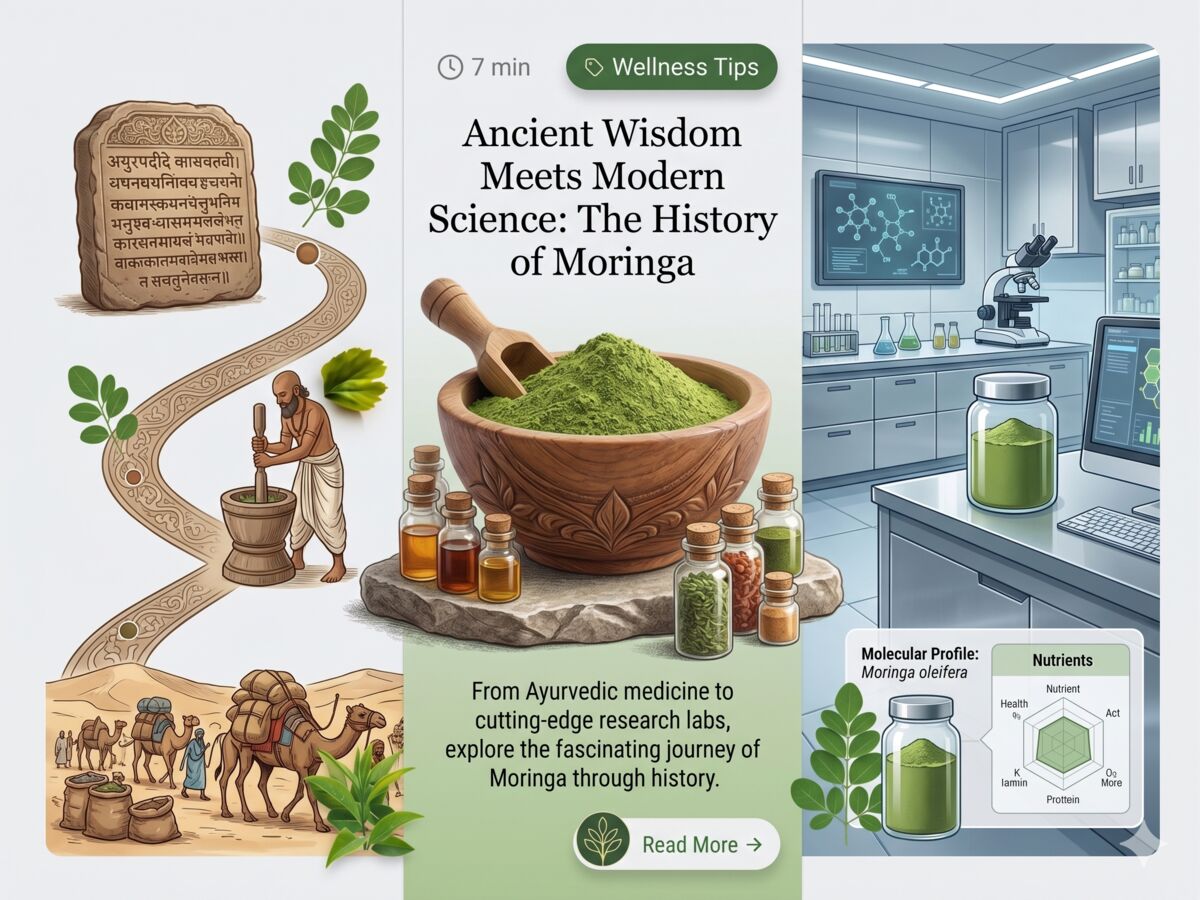
Moringa oleifera has a rich history spanning thousands of years and multiple continents. Its journey from ancient remedy to modern superfood is a testament to its enduring value — and its roots run deepest in India, where it originated and where the conditions for growing truly nutrient-dense Moringa remain unmatched.
Ancient Origins (2000+ BCE)
Moringa's story begins in the foothills of the Himalayas in the Indian subcontinent — the same region where it is still grown today for the highest-quality nutrition supplements:
- Ayurvedic Medicine: Ancient texts document over 300 ailments treated with Moringa
- Sanskrit Name: "Shobhanjana" meaning "very auspicious tree"
- Royal Use: Reportedly used by ancient Maurya warriors to boost energy and relieve stress
Spread Across Cultures
Moringa's reputation spread along ancient trade routes:
- Egypt: Ancient Egyptians used Moringa oil for skincare and preservation
- Greece & Rome: Valued for its oil and as a natural water purifier
- Africa: Became essential for combating malnutrition across the continent
- Philippines & Southeast Asia: "Malunggay" became a dietary staple
Traditional Uses
Across cultures, Moringa was used for:
- Treating over 300 conditions in traditional medicine
- Purifying water (seeds have coagulant properties — see why whole-plant formulation matters)
- Nourishing pregnant and nursing mothers
- Providing complete nutrition in times of scarcity
- Creating healing oils and poultices
Modern Scientific Validation
The 20th and 21st centuries brought scientific tools to validate ancient claims:
- Nutritional Analysis: Confirmed extraordinary nutrient density
- Phytochemical Studies: Identified over 40 antioxidants and bioactive compounds
- Clinical Trials: Testing effects on blood sugar, cholesterol, and inflammation
- Molecular Research: Understanding mechanisms of action
The Name "Moringa"
The name derives from the Tamil word "murungai," reflecting its deep South Indian heritage. Today, Moringa grows in tropical and subtropical regions worldwide — but its nutritional profile is strongest when grown in its native Indian environment, where centuries of cultivation knowledge, ideal climate, and soil conditions align.
This is why sourcing matters. A Moringa plant grown in its origin region, by growers who have cultivated it for generations, starts with a nutritional advantage that processing alone cannot replicate.
From Ancient Wisdom to Modern Standards
The history of Moringa is remarkable — but history alone doesn't make a product worth taking.
What bridges ancient wisdom and modern use is the integrity of how the plant is sourced, harvested, and processed today. Moringa grown in India, harvested at peak nutritional maturity, and shade-dried to preserve what thousands of years of tradition recognized as valuable — that's the product that honors what this plant actually is.
Modern science has now confirmed what Ayurvedic practitioners observed thousands of years ago. The question today is whether the product in your hand was made with the same care that ancient cultures applied to this plant — or whether it was mass-produced for convenience, with nutrition as an afterthought.
Looking Forward
As research continues, Moringa is increasingly recognized not just as a superfood but as a potential solution for global malnutrition—truly a gift that keeps giving across millennia.
Scientific References
1. Leone A, Spada A, Battezzati A, et al. Cultivation, Genetic, Ethnopharmacology, Phytochemistry and Pharmacology of Moringa oleifera Leaves: An Overview. Int J Mol Sci. 2015;16(6):12791-12835. Comprehensive overview including ethnopharmacology, traditional uses across cultures, and identification of bioactive compounds. PubMed
2. Anwar F, Latif S, Ashraf M, Gilani AH. Moringa oleifera: a food plant with multiple medicinal uses. Phytother Res. 2007;21(1):17-25. Documents moringa's historical use in Ayurvedic medicine, traditional applications, and modern nutritional analysis. PubMed
3. Abdull Razis AF, Ibrahim MD, Kntayya SB. Health benefits of Moringa oleifera. Asian Pac J Cancer Prev. 2014;15(20):8571-8576. Review of moringa's phytochemical profile including antioxidants and bioactive compounds. PubMed
These references support the historical and compositional claims in this article. For our full evidence-review methodology, see [how we assess evidence](/editorial-standards).
This article is for educational purposes and is not medical advice. Speak with a qualified healthcare provider before starting any new supplement.
About the Formulator
Vital 1 by CoLab was formulated by Joshua Plant, PhD, a biomedical scientist with a Harvard doctorate and over 13 years of expertise in botanical formulation and nutritional science. His work focused on whole-plant sourcing, evidence-based ingredient selection, and shade-dried processing to preserve the full spectrum of nutrients.
Learn more about Joshua Plant, PhD and the science behind Vital 1Vital 1 — Where Ancient Wisdom Meets Modern Standards
Vital 1 by CoLab brings together India-sourced Moringa — grown in the plant's origin region — with shade-drying that preserves its nutritional integrity, whole-plant use of leaves, seeds, and fruit, and third-party testing to verify what's actually inside.
Now available. Connect with a Wellness Guide to get started and unlock exclusive offers.
🎁 Connect with a Wellness Guide to unlock exclusive offers and member-only perks.
Get StartedWhere would you like to go from here?
No pressure — just a few ways to take the next step, whenever you're ready.
Explore the research
Dig into what the studies actually show about moringa across different areas of health.
Read the benefitsTry it yourselfMake it part of your day
See Vital 1 — whole-plant moringa with 8 supporting botanicals — and how to get started.
Discover Vital 1Share it forwardHelp others learn too
If moringa has helped you, there is a calm way to share it with others — on your terms.
Explore the path