By the Powered By Moringa Editorial Team
Moringa's popularity has outpaced most people's ability to tell a good product from a mediocre one. Walk down any supplement aisle, or scroll any wellness storefront, and you'll find dozens of moringa powders and capsules that look nearly identical on the outside — but vary enormously in quality, sourcing, and what's actually inside the bottle.
Here's what to actually check before you buy.
1. Which Part of the Plant Is Actually In It
This is the single most important — and most commonly skipped — question, and it matters for more than just potency.
*Moringa oleifera* is often marketed as a "whole plant" superfood, and different parts of the tree genuinely do offer different benefits: leaves are the most nutrient-dense and the most extensively studied part, pods (the "drumstick" fruit) are a traditional food source, and seeds and other plant parts show up in some formulations too. But "whole plant" is a vague term unless a label tells you exactly which parts are included and in what proportion.
This isn't just a quality question — it's a safety-relevant one. Some plant parts (particularly root, bark, and flower) carry specific caution flags for certain life stages, like pregnancy, that don't apply to leaf. A shopper who is pregnant, breastfeeding, or simply cautious about what they're taking has no way to make an informed choice if a label just says "moringa blend" without specifying which parts of the plant are inside.
What to look for: A label or product page that explicitly lists which plant parts are used — "100% leaf," or a clear breakdown if it's a multi-part blend. If a brand can't tell you what's in their "whole plant" formula, that's a real gap, not a marketing detail to skip past.
2. Where and How It Was Grown
Moringa is not a delicate crop — it's drought-tolerant and grows in a wide range of soils, which is part of why it's such a valuable plant for food-insecure regions. But that hardiness also means it can absorb whatever is in the soil and water around it, including heavy metals and contaminants, if grown in poor conditions or near industrial or roadside pollution.
What to look for: Named country or region of origin, and ideally some indication of testing for heavy metals, pesticides, and microbial contamination. "Sourced from [specific country/region]" is a better sign than no origin information at all.
3. How It Was Dried and Processed
Moringa leaves lose a meaningful share of their nutrient content when exposed to high heat or direct sunlight during drying. Shade-drying at controlled, lower temperatures is the traditional and still-preferred method for preserving nutrients, color, and flavor.
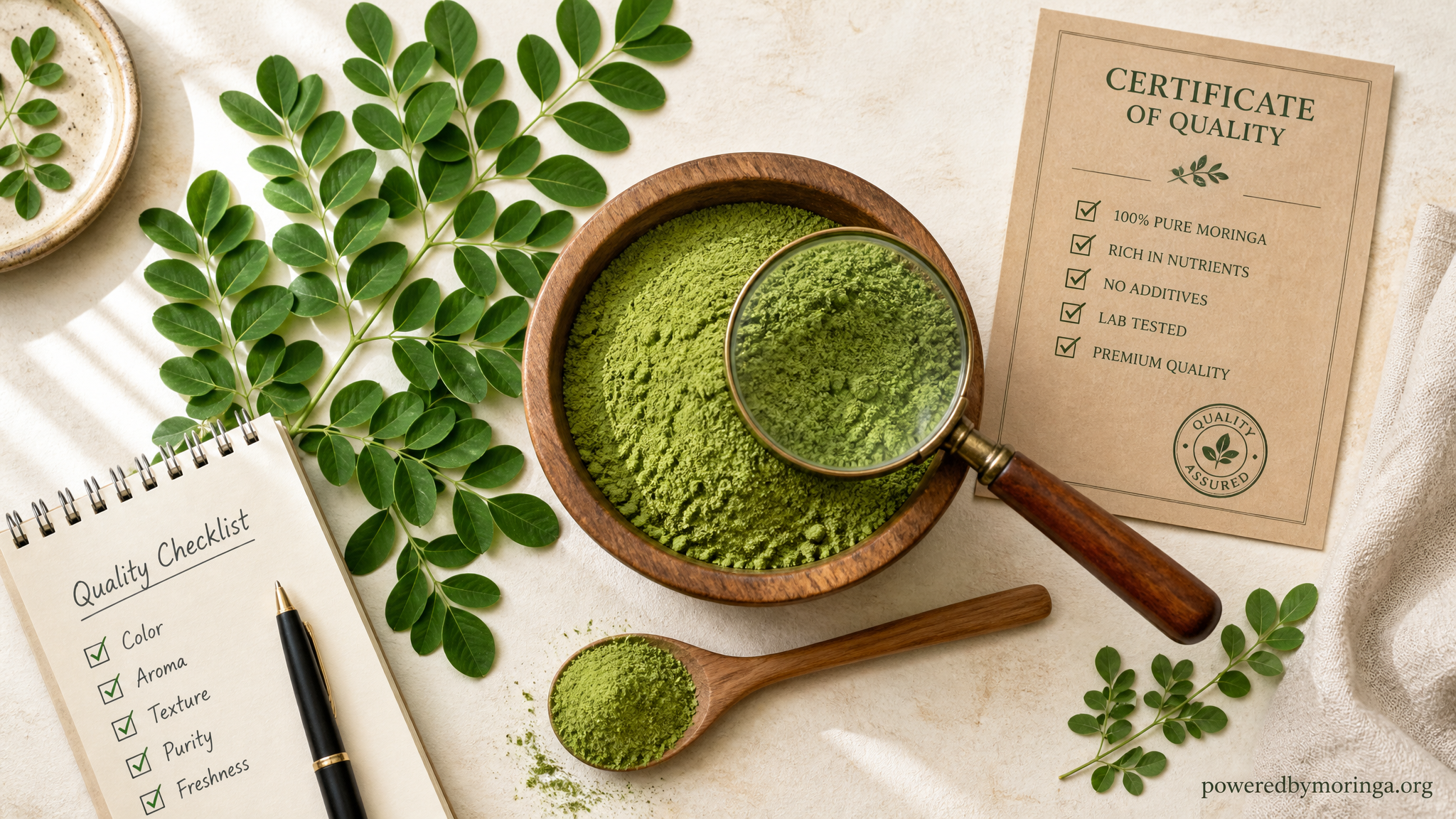
What to look for: Bright, deep green powder (a dull, brownish-green color is a sign of heat damage or age) and, where a brand shares it, mention of low-temperature or shade-drying in their process.
4. Third-Party Testing and Certifications
Because moringa is regulated as a food or supplement rather than a drug in most countries, quality control varies enormously between brands. Third-party testing is one of the few ways a shopper can verify a product's claims independently rather than taking a label at its word.
What to look for: Certificates of analysis (COAs) available on request or published online, testing for heavy metals and microbial contamination, and recognized quality certifications where applicable (organic certification, Good Manufacturing Practice/GMP compliance, or similar).
5. Whether Claims Match Reality
Moringa is a genuinely nutrient-dense plant with a long history of traditional use — it doesn't need exaggerated claims to be worth taking seriously. Be cautious of any product promising to cure, treat, or prevent a specific disease; legitimate supplement marketing is restricted to structure/function language ("supports") or clearly labeled traditional-use claims, not disease treatment claims. A brand making bold medical promises is often a brand cutting corners elsewhere too.
What to look for: Language like "supports" or "traditionally used for," clear sourcing and testing information, and a company willing to explain its process rather than just its promises.
The Short Version
Before you buy, a good moringa product should be able to answer, clearly and specifically:
- Which parts of the plant are actually in it
- Where it was grown
- How it was dried and processed
- Whether it has been third-party tested
- Whether its claims are appropriately scoped, not overstated
If a brand can answer all five without hedging, that's a strong signal you're looking at a product built on substance rather than marketing.
The 5 Questions to Ask Before You Buy
Keep these five questions handy the next time you're comparing products:
1. Which parts of the moringa plant are included?
2. Where was it grown?
3. How was it dried and processed?
4. Can the company provide independent testing or a COA?
5. Do the claims sound credible — or too good to be true?
If you can't get clear answers, keep looking.
Sources & Further Reading
1. Health Canada. *Licensed Natural Health Products Database — Moringa products.* The official registry of moringa products licensed for sale in Canada, showing the approved claim language and labeling standards each product has attested to.
2. National Library of Medicine (PMC). *Moringa oleifera: A Review on the Ethnobotany, Phytochemistry and Pharmacological Uses.* Documents nutrient variation across different plant parts and processing methods.
3. World Agroforestry (ICRAF). *Agroforestree Database: Moringa oleifera species profile.* Reference on moringa's growing conditions and environmental tolerance, relevant to sourcing quality.
This article is for educational purposes only and is not a recommendation of any specific product or brand.
About the Formulator
Vital 1 by CoLab was formulated by Joshua Plant, PhD, a biomedical scientist with a Harvard doctorate and over 13 years of expertise in botanical formulation and nutritional science. His work focused on whole-plant sourcing, evidence-based ingredient selection, and shade-dried processing to preserve the full spectrum of nutrients.
Learn more about Joshua Plant, PhD and the science behind Vital 1Quality You Can Actually Verify.
A good moringa should be able to answer every question on this checklist. Vital 1 by CoLab is built on whole-plant, India-sourced moringa — clearly sourced, harvested at peak maturity, and shade-dried to protect its nutrients.
Now available. Connect with a Wellness Guide to get started and unlock exclusive offers.
🎁 Connect with a Wellness Guide to unlock exclusive offers and member-only perks.
Get StartedWhere would you like to go from here?
No pressure — just a few ways to take the next step, whenever you're ready.
Explore the research
Dig into what the studies actually show about moringa across different areas of health.
Read the benefitsTry it yourselfMake it part of your day
See Vital 1 — whole-plant moringa with 8 supporting botanicals — and how to get started.
Discover Vital 1Share it forwardHelp others learn too
If moringa has helped you, there is a calm way to share it with others — on your terms.
Explore the path