Two Plants. Same Species. Very Different Nutrition.
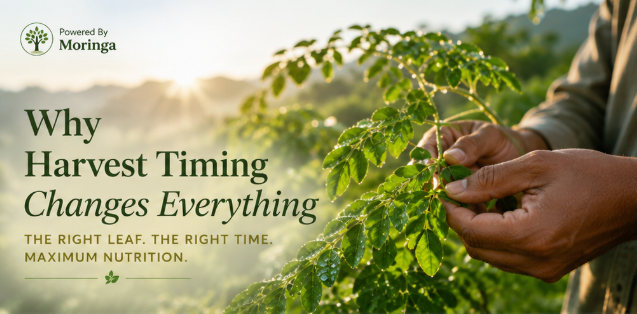
Take two Moringa plants, grown in the same region, same soil, same climate. Harvest one at peak nutritional maturity. Harvest the other two weeks later for logistical convenience — because the truck is already coming, or the processing facility has capacity that day.
Are they the same product?
Nutritionally, no. Not even close.
This is one of the least-talked-about factors in plant-based nutrition — and one of the most important. The moment a plant is harvested, its nutritional clock starts running. And the moment before harvest, there's a window of peak nutritional density that, once passed, cannot be recovered in processing.
Nutrition Peaks at a Specific Moment
Plants accumulate nutrients, antioxidants, and phytonutrients as they grow. That accumulation isn't linear — it builds toward a peak, and then begins to decline.
For Moringa, this is measurable. A 2026 metabolomics study profiled Moringa leaves across different growth stages and was able to identify an optimal maturity stage — the point at which the leaf's metabolite profile is richest — rather than treating all leaves as interchangeable [1]. Younger leaves haven't fully developed their profile yet. Leaves left on the plant too long have moved past it.
In commercial agriculture, harvest timing is almost never optimized for nutrition. It's optimized for yield, logistics, and shelf life. Plants are harvested when it's convenient — when machinery is available, when the processing schedule allows, when the transport is arranged.
The result is a product that may look identical to peak-harvested Moringa but delivers meaningfully less nutritional value.
What Happens After Harvest Matters Just as Much
Even perfectly timed harvesting can be undone by poor processing.
The most common method of drying Moringa — and most plant-based ingredients — is high-heat processing. It's fast, it's cheap, and it works well for shelf life.
What it doesn't do well is preserve nutrition.
This is one of the better-documented parts of the Moringa literature. Studies that directly compare dehydration methods find that the drying method has a significant effect on how much of the leaf's carotenoids, tocopherols, ascorbic acid and overall antioxidant activity survive into the finished powder [2]. A 2025 study looking at drying conditions and bioactive preservation reached the same broad conclusion: temperature and exposure are not neutral variables [3].
The compounds most at risk are the heat- and light-sensitive ones — vitamin C in particular, along with certain carotenoids and delicate phytonutrients.
Shade-drying is slower and more expensive. It means drying the leaves at ambient temperature, away from direct sunlight and heat, over a longer period. Because both high heat and direct UV exposure degrade these compounds, gentler drying generally preserves more of them — which is why shade-drying is preferred over open sun-drying or fast high-heat processing.
There is a visual cue that tracks this reasonably well: carefully shade-dried Moringa tends to stay a vibrant green, while harshly processed Moringa browns. Colour is not a laboratory assay, but chlorophyll and carotenoid degradation happen under the same conditions that damage other sensitive nutrients — so a dull brown powder is at least a reason to ask questions.
Why Sourcing Location Matters
Not all growing regions are equal for Moringa.
Moringa oleifera originated in the sub-Himalayan regions of northern India and has been cultivated there for a very long time [4]. Indian growing conditions — climate, soil, and long-established cultivation practice — remain a strong starting point for the crop.
It is worth being precise about what is and isn't established here. Compositional reviews document that Moringa's nutrient content varies substantially with cultivar, soil, climate, season and agronomic practice [4]. What that supports is the claim that where and how it is grown changes the product. It does not, on its own, prove that Indian-grown Moringa is nutritionally superior to well-grown Moringa from anywhere else — and we're not going to claim it does.
As Moringa has grown in global popularity, cultivation has expanded to many regions — some well-suited, some less so. The nutritional profile of Moringa can vary considerably depending on where it's grown, how the soil is managed, and how long growing practices have been established.
What matters, then, is less the country on the label than whether the grower knows their crop and can tell you about it. Sourcing from India — where the plant originated and where cultivation expertise is deepest — is a reasonable way to buy into that expertise. It is a sourcing decision, not a guarantee, and it should come with the same traceability questions you'd ask of any origin.
Why the Whole Plant Matters
Most Moringa products use only the leaves. That's partly tradition, partly convenience — the leaves are the easiest part to process and the most recognized.
But the Moringa plant produces more than leaves. The seeds are a source of oleic-acid-rich oil and their own set of phytochemicals; the pods — sometimes called drumsticks — are eaten as a vegetable and contribute vitamin C and fibre. Different parts of the plant have genuinely different compositions [4][5].
Using only the leaves means leaving part of the plant's nutritional contribution on the table. To be clear about the limits of the evidence: we are not aware of a controlled human trial showing that a whole-plant Moringa preparation outperforms a leaf-only one. The case for whole-plant use is a compositional one, not a clinical one.
Whole-plant nutrition means using what the plant actually offers — leaves, seeds, and fruit — in a form that works together the way the plant intended.
What This Means When Choosing a Product
Most supplement labels don't tell you when their Moringa was harvested. They don't tell you how it was dried. They don't specify the growing region or whether the whole plant was used.
That's not an accident. Most products can't make those claims because they don't control those variables — they source from commodity suppliers and don't track the chain between field and finished product.
The questions worth asking about any Moringa product:
- Where was it grown, and is that region verified?
- Was it harvested at peak nutritional maturity?
- How was it processed after harvest — high-heat or shade-dried?
- Does it use the whole plant or just the leaves?
- Has it been third-party tested to verify what's actually in it?
These aren't premium features. They're the baseline for a product that does what it claims.
The Bottom Line
A Moringa product is only as good as the decisions made before it reached the bottle — or the sachet.
Harvest timing. Processing method. Growing region. Whole-plant use. Third-party testing. These are the variables that determine whether a plant-based nutrition product actually delivers the nutrition it promises.
Most products don't talk about this. That's worth noticing.
Scientific References
1. Azlan UK, et al. Integrative metabolomics using untargeted UHPLC-MS/MS and chemometrics identifies optimal maturity stage of Moringa oleifera leaves from Kuala Terengganu, Malaysia. PeerJ. 2026;14:e20938. Plant metabolomics study. PubMed
2. Effect of dehydration methods on retention of carotenoids, tocopherols, ascorbic acid and antioxidant activity in Moringa oleifera leaves and preparation of a RTE product. J Food Sci Technol. 2014;51(9):2176-82. Comparative processing study. PubMed
3. Effect of drying conditions on the preservation of selected bioactive compounds in Moringa oleifera aqueous extract. BMC Plant Biol. 2025;25(1):1432. Processing study. PubMed
4. Leone A, Spada A, Battezzati A, et al. Cultivation, Genetic, Ethnopharmacology, Phytochemistry and Pharmacology of Moringa oleifera Leaves: An Overview. Int J Mol Sci. 2015;16(6):12791-12835. Compositional and agronomic review. PubMed
5. Medicinal utilization and nutritional properties of drumstick (Moringa oleifera) — A comprehensive review. Food Sci Nutr. 2024;12(7):4546-4568. Review covering leaf, pod and seed composition. PubMed
This article is for educational purposes only and does not constitute medical advice. Read more about [how we assess evidence](/editorial-standards).
About the Formulator
Vital 1 by CoLab was formulated by Joshua Plant, PhD, a biomedical scientist with a Harvard doctorate and over 13 years of expertise in botanical formulation and nutritional science. His work focused on whole-plant sourcing, evidence-based ingredient selection, and shade-dried processing to preserve the full spectrum of nutrients.
Learn more about Joshua Plant, PhD and the science behind Vital 1This Is What Makes Vital 1 Different
Vital 1 by CoLab was built around these principles from the start. India-sourced Moringa, harvested at peak nutritional maturity. Shade-dried to preserve nutrients and antioxidants. Whole-plant — leaves, seeds, and fruit. Third-party tested.
Not all Moringa is created equal. Vital 1 was designed to be.
Now available. Connect with a Wellness Guide to get started and unlock exclusive offers.
🎁 Connect with a Wellness Guide to unlock exclusive offers and member-only perks.
Get StartedWhere would you like to go from here?
No pressure — just a few ways to take the next step, whenever you're ready.
Explore the research
Dig into what the studies actually show about moringa across different areas of health.
Read the benefitsTry it yourselfMake it part of your day
See Vital 1 — whole-plant moringa with 8 supporting botanicals — and how to get started.
Discover Vital 1Share it forwardHelp others learn too
If moringa has helped you, there is a calm way to share it with others — on your terms.
Explore the path