Another Green Powder, Another Different Organism
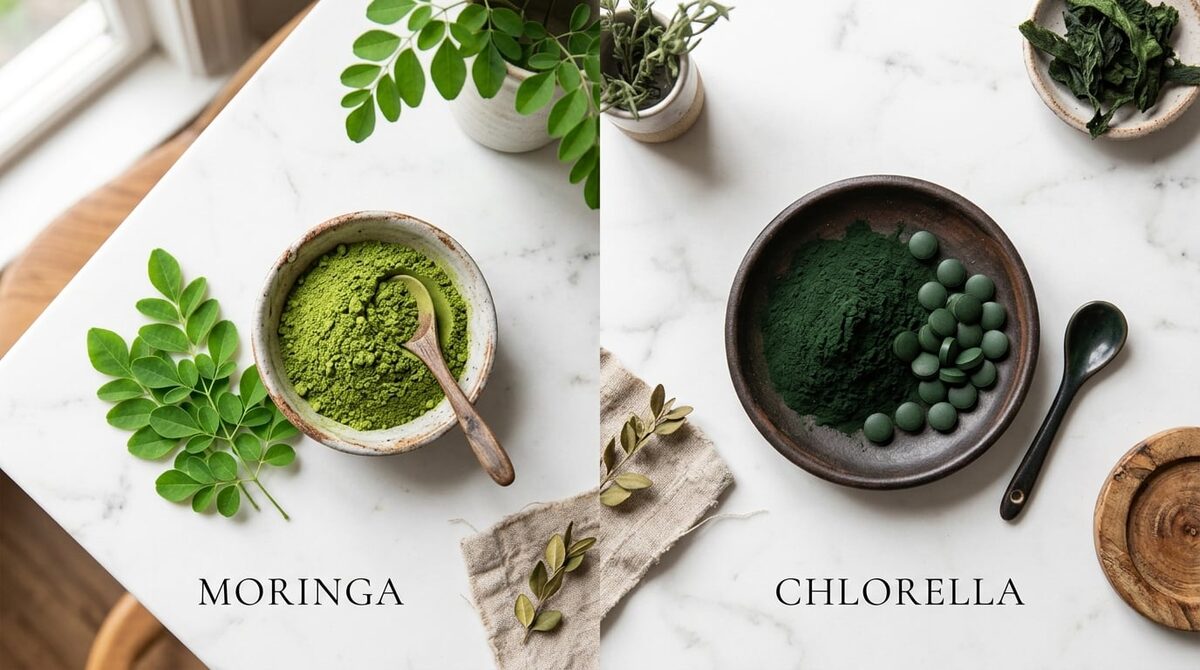
Chlorella often gets grouped with moringa and spirulina under the same "green superfood" umbrella — but like spirulina, chlorella isn't a plant at all. It's a single-celled freshwater algae, and its unique biology gives it a genuinely different nutritional profile and use case than moringa.
This article is for the specific question "is chlorella's detox reputation real, and how does it compare to Moringa?" For the broader picture across all the green powders, start with our hub: Moringa vs Other Superfoods: How to Compare Them Honestly.
What They Actually Are
Chlorella is a genus of single-celled green freshwater algae. It's grown in controlled aquaculture systems, harvested, and the cell walls are typically "cracked" through a mechanical process before drying — because chlorella's cell wall is naturally difficult for the human digestive system to break down on its own.
Moringa is the leaf of a fast-growing land tree, Moringa oleifera, harvested and dried much like any leafy green.
The "cracked cell wall" detail about chlorella is actually important — it's a manufacturing step that doesn't apply to moringa at all, since moringa leaf doesn't have the same digestibility barrier.
The Detox Claim, Examined Honestly
Chlorella is widely marketed around "detoxification," particularly the idea that it binds heavy metals and helps the body eliminate them. Here is what actually sits behind that.
The strongest evidence is environmental, not human. Chlorella vulgaris is genuinely used in phycoremediation — removing heavy metals and other contaminants from polluted water [1]. That's a real, well-documented capability. It is also a completely different setting from your digestive tract.
The human evidence is thin. The most frequently cited human study is a small 2019 trial in patients with dental amalgam restorations, which reported reduced mercury and tin levels after 90 days [2]. Note the important limitation: that study used a combined supplement — chlorella plus Fucus extract plus aminosulphurates — so it cannot tell you what chlorella alone did. Chlorella has also been studied for other outcomes, but the detox claim specifically does not yet rest on large, well-controlled trials [3].
Moringa doesn't carry the same detox marketing angle. Its research base centres on nutrient density and antioxidant content. Moringa does have liver-related research, but it is largely animal work — we walk through those limitations honestly in Does Moringa Protect Your Liver?.
If "detox" is the reason you're considering either of these, the honest answer is that your liver and kidneys already do that job, and neither powder has been shown to meaningfully improve on them in a healthy person.
Nutritional Comparison
Chlorella's strengths: High protein content — reported anywhere from roughly 20% to 60%+ of dry weight depending on strain and how it was grown, which is worth knowing before you trust any single number on a label [3]. It also carries a high chlorophyll content, B vitamins, iron and carotenoids [3].
One term to treat with caution: "chlorella growth factor" is a supplement-industry marketing name for a nucleotide-peptide extract, not a defined nutrient with established human benefits. We've removed it from our own description for that reason.
Moringa's strengths: All nine essential amino acids, a broad vitamin and mineral spread (iron, calcium, provitamin A, vitamin C) and its own antioxidant profile of flavonoids and isothiocyanates [4] — plus a milder flavour that's generally easier to incorporate into food and drink.
Taste and Practical Use
Chlorella has a strong, distinctly "pond water" or seaweed-like flavor that most people find difficult to take outside of capsule form.
Moringa has a comparatively mild, earthy flavor that's far easier to work into smoothies, juices, or flavored powder blends — part of why it's more commonly found in palatable, flavored formats.
Sourcing and Safety Considerations
Like spirulina, chlorella is grown in water-based systems, which means contamination control is a critical safety factor — heavy metal contamination and harmful algae bloom risk are real concerns with poorly controlled chlorella sourcing. Reputable chlorella products require rigorous testing for this reason.
Moringa, as a land-grown crop, has different sourcing priorities: growing region, harvest timing, and drying method (shade-dried versus high-heat) are the primary quality factors.
Which One Should You Choose?
Choose chlorella if: you're specifically interested in its chlorophyll and protein content and don't mind capsule form — and you've read the detox evidence above with clear eyes.
Choose moringa if: you want a broader nutrient profile, an easier flavor experience, and whole-plant nutrition without the cell-wall processing chlorella requires.
Use both if: you're building a comprehensive supplement routine and want chlorella's unique compounds alongside moringa's broader nutritional base.
The Bottom Line
Chlorella and moringa are both called superfoods, but they come from entirely different biological origins and serve different purposes. Chlorella's reputation rests heavily on detox-adjacent claims whose strongest support is environmental rather than clinical. Moringa's research base is more centred on nutrient density — and has its own quality limitations. Neither is a magic bullet; both are simply different nutritional tools.
Scientific References
1. Comparative Evaluation of Chlorella vulgaris and Anabaena variabilis for Phycoremediation of Polluted River Water: Spotlighting Heavy Metals Detoxification. Biology (Basel). 2023;12(5). Environmental remediation study. PubMed
2. Merino JJ, et al. The Long-Term Algae Extract (Chlorella and Fucus sp) and Aminosulphurate Supplementation Modulate SOD-1 Activity and Decrease Heavy Metals Levels in Patients with Long-Term Dental Titanium Implants and Amalgam Fillings Restorations. Antioxidants (Basel). 2019;8(4):101. Small human study of a combined supplement. PubMed
3. Panahi Y, et al. Chlorella vulgaris: A Multifunctional Dietary Supplement with Diverse Medicinal Properties. Curr Pharm Des. 2016;22(2):164-73. Composition and pharmacology review. PubMed
4. Leone A, Spada A, Battezzati A, et al. Cultivation, Genetic, Ethnopharmacology, Phytochemistry and Pharmacology of Moringa oleifera Leaves: An Overview. Int J Mol Sci. 2015;16(6):12791-12835. Compositional review. PubMed
This article is for educational purposes only and does not constitute medical advice. Nothing here should be read as a claim that any food removes toxins or heavy metals from the body. Read more about [how we assess evidence](/editorial-standards).
About the Formulator
Vital 1 by CoLab was formulated by Joshua Plant, PhD, a biomedical scientist with a Harvard doctorate and over 13 years of expertise in botanical formulation and nutritional science. His work focused on whole-plant sourcing, evidence-based ingredient selection, and shade-dried processing to preserve the full spectrum of nutrients.
Learn more about Joshua Plant, PhD and the science behind Vital 1Looking for the Whole-Plant, Easy-to-Use Option?
Vital 1 by CoLab uses whole-plant, India-sourced, shade-dried Moringa as its foundation — no cracked cell walls, no capsules required, and a flavor designed to actually be enjoyable.
Now available. Connect with a Wellness Guide to get started and unlock exclusive offers.
🎁 Connect with a Wellness Guide to unlock exclusive offers and member-only perks.
Get StartedWhere would you like to go from here?
No pressure — just a few ways to take the next step, whenever you're ready.
Explore the research
Dig into what the studies actually show about moringa across different areas of health.
Read the benefitsTry it yourselfMake it part of your day
See Vital 1 — whole-plant moringa with 8 supporting botanicals — and how to get started.
Discover Vital 1Share it forwardHelp others learn too
If moringa has helped you, there is a calm way to share it with others — on your terms.
Explore the path