
By the Powered By Moringa Editorial Team
A tree can travel a long way without leaving its roots behind.
Moringa oleifera is native to the Indian subcontinent, but today it is grown across tropical and subtropical regions of the world. Along the way, different communities have given it different names, cultivated different parts of the tree, and developed their own ways of bringing it into everyday life.
In one kitchen, moringa might mean tender pods simmered in a curry. Somewhere else, it might mean a handful of leaves added to soup. In another community, the dried leaves may be used in a simple food preparation, while the seeds have a very different practical history.
The fascinating part isn't simply where moringa grows.
It's how people have made the tree their own.
A Note About Tradition and Evidence
Moringa has a long history of culinary and traditional use, and those traditions are an important part of its cultural story.
But traditional use is not the same thing as clinical evidence.
Throughout this article, we'll describe how different communities have traditionally used moringa as a food, household plant, or traditional preparation. These examples are cultural history — not recommendations that moringa can prevent, treat, or cure a health condition.
That distinction matters, particularly when a plant has become popular in the modern wellness market.
India: From Kitchen Staple to Traditional Herbal Use
Moringa's story begins in South Asia, and India remains one of the places where the tree is most deeply woven into everyday food culture.
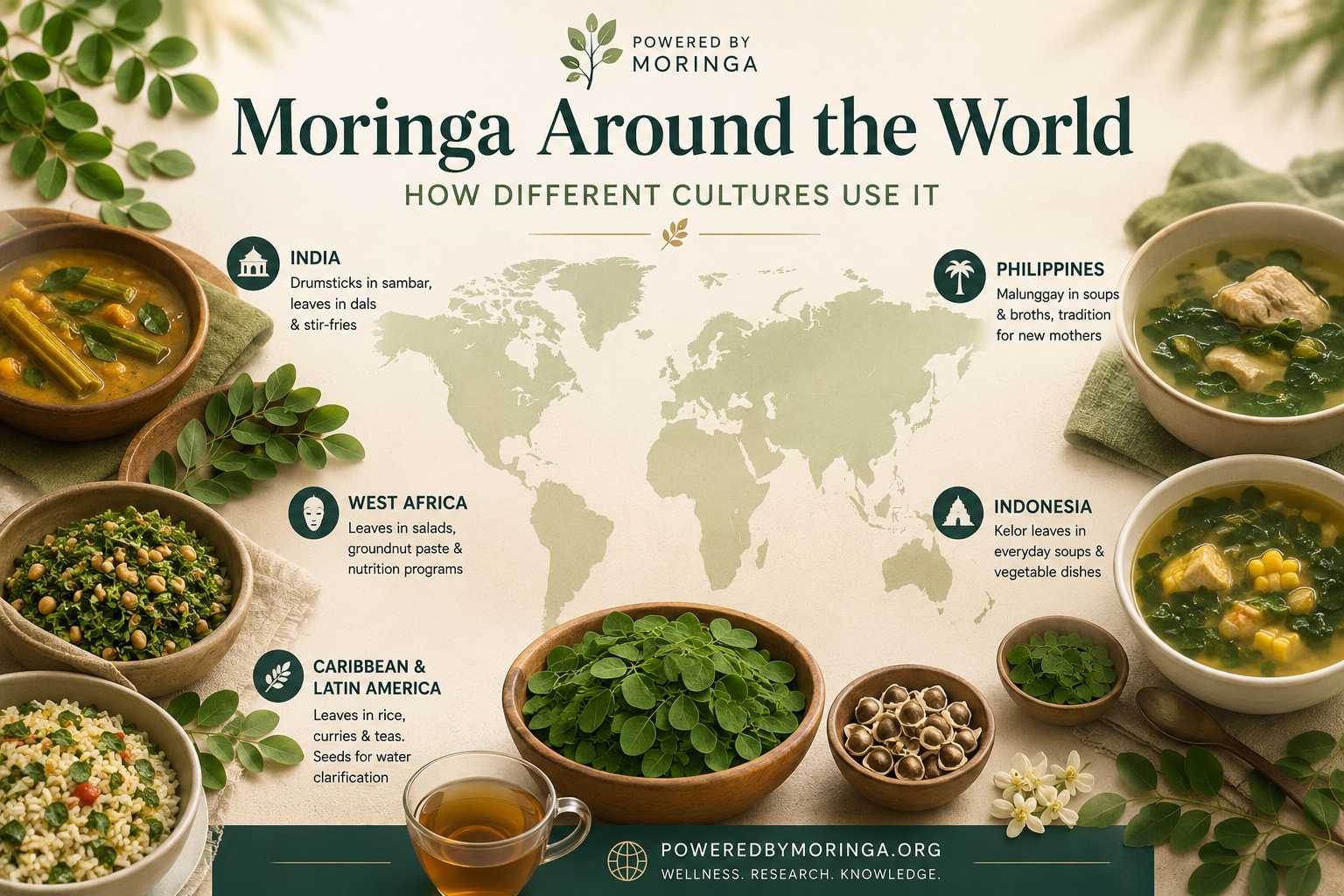
The young pods are commonly known as drumsticks and are used as a vegetable in dishes such as sambar, a lentil-based preparation particularly associated with South Indian cooking. The leaves can also be cooked as greens, incorporated into dals and other dishes, or prepared in a variety of regional recipes.
The World Agroforestry database documents the leaves being used much like spinach, while the young pods are valued as a vegetable and prepared in several different ways.
Moringa also has a long history in India's traditional systems of herbal practice. Different parts of the plant have been described in traditional texts and regional practices, giving moringa a dual identity that continues today:
food in the kitchen, and a plant with a traditional herbal history.
That distinction is worth preserving. A food tradition tells us how people have used a plant; it doesn't automatically establish what modern clinical research has proven about it.
The Philippines: Malunggay in Everyday Cooking
In the Philippines, moringa is commonly known as malunggay and has a familiar place in home cooking.
The leaves are used in soups, broths, and vegetable dishes, where they can be added near the end of cooking. One well-known example is tinola, a traditional chicken soup that commonly combines chicken, ginger, vegetables, and malunggay leaves.
The plant's culinary role is part of a much broader Philippine food tradition in which leafy vegetables are incorporated into everyday meals rather than treated as specialty ingredients.
Malunggay has also developed a cultural association with postpartum nutrition and breastfeeding. That traditional use is particularly interesting because it has subsequently attracted scientific research — although cultural practice and clinical evidence should still be considered separately.
For a closer look at what research actually says about moringa during pregnancy and breastfeeding, see our companion article:
[Moringa in Pregnancy & Breastfeeding: What the Research Says](/blog/moringa-in-pregnancy-and-breastfeeding)
West Africa: A Practical Food Crop
Moringa's story takes another shape across parts of West Africa.
Here, the tree has often been valued for practical reasons: it grows relatively quickly, its leaves can be eaten, and the plant can provide a source of green food in environments where growing conditions can be challenging.
The leaves are used in a variety of local dishes and food preparations. In some regions they are eaten fresh, while in others they are dried and incorporated into foods in powdered form.
Moringa's adaptability has helped make it an important vegetable tree across tropical regions of Africa, Asia, and Latin America. Agricultural literature describes the leaves being used in soups, sauces, salads, cooked vegetables, and teas, while the young pods are also widely eaten.
This is one of the less glamorous but more important parts of moringa's history.
It isn't simply a plant people discovered recently and decided to put into capsules.
For many communities, it has simply been a useful tree growing close to home.
Indonesia: Kelor in Everyday Food
In Indonesia, moringa is commonly known as kelor.
Its leaves are used in traditional cooking, including soups and other simple vegetable dishes. The leaves can be cooked alongside ingredients such as corn and squash, creating the kind of uncomplicated meal that makes sense when a plant is readily available in the garden or local market.
That everyday familiarity is part of what makes moringa's global story so interesting.
In many places, it isn't treated as an exotic superfood.
It's a vegetable.
The World Agroforestry database documents moringa's use as a food crop across a wide range of regions, including the use of leaves, flowers, and young pods in everyday food preparations.
The Caribbean and Latin America: A Tree That Adapted
Moringa eventually made its way into the Caribbean and Latin America, where it became part of local agricultural and food traditions.
In Spanish-speaking regions, names such as marango are used for the plant. Depending on the country and household, the leaves may be cooked as greens, added to soups or stews, incorporated into rice and other dishes, or prepared as a tea.
The plant's introduction to the Americas is well documented, and modern agricultural literature describes moringa as a vegetable tree now cultivated widely throughout tropical Latin America as well as Africa and Asia.
There is another fascinating chapter to the story here: the seeds.
Moringa seeds contain compounds that can act as natural coagulants, causing suspended particles in cloudy water to clump together. This property has been studied for its potential applications in water treatment and has a long history of practical interest in several regions.
That doesn't make moringa seed a household water-treatment solution today — but it does illustrate just how many different ways people have found to make use of the same tree.
One Tree, Many Names
Part of moringa's cultural history can be found in its names.
Across different languages and regions, Moringa oleifera has accumulated an impressive collection of common names, including:
- Moringa
- Drumstick tree
- Malunggay
- Kelor
- Marango
- Sahjan
- Sajna
- Ben oil tree
- Horseradish tree
World Agroforestry's species database documents a wide range of regional names, reflecting just how widely the tree has travelled and how deeply it has been incorporated into local cultures.
And the names often reveal something about how people relate to the plant.
"Drumstick tree" reflects the distinctive shape of its young pods.
"Malunggay" and "kelor" identify it within entirely different linguistic and cultural traditions.
The names change.
The tree remains.
One Tree, Many Kitchens
Look closely at the world's moringa traditions and a pattern begins to emerge.
People have found remarkably different ways to work with the same plant.
The leaves become vegetables, soup ingredients, teas, and dried preparations.
The young pods become a familiar ingredient in curries, stews, and other dishes.
The flowers can be eaten or used in traditional preparations.
The seeds have been used for oil and have also attracted interest because of their natural coagulating properties.
And the tree itself has found a place in gardens, farms, hedges, and smallholder agricultural systems across much of the tropics.
That doesn't mean every traditional use has been scientifically validated. It doesn't mean every preparation is appropriate for every person. And it certainly doesn't mean that a plant's history should be confused with evidence for treating disease.
What it does tell us is something more interesting.
Moringa has been useful to people in many different places, for many different reasons, for a very long time.
Its story isn't just the story of a supplement.
It's the story of a food plant, an agricultural crop, a household tree, and a piece of cultural knowledge that has travelled across continents.
What We Can Learn From the Tradition
Modern wellness culture sometimes presents moringa as though its story began when someone put green powder into a pouch.
It didn't.
Long before moringa appeared in smoothies and wellness products, people were growing it, cooking it, naming it, sharing recipes, and finding practical uses for different parts of the tree.
That history deserves to be understood on its own terms.
Traditional knowledge can tell us what people have valued and how they have used a plant. Scientific research can help us investigate questions about nutrition, safety, chemistry, and potential biological effects.
The two can inform one another — but they are not interchangeable.
At Powered By Moringa, we think that's an important distinction.
Because the more you learn about the real story of moringa, the less you need the hype.
The Takeaway
Moringa is not one tradition.
It is many traditions growing around one remarkable tree.
From South Indian kitchens to Philippine soups, from West African food traditions to Indonesian gardens and Latin American households, communities have developed their own relationships with Moringa oleifera.
Different names.
Different recipes.
Different customs.
One tree.
And that may be one of the most interesting things about moringa of all.
Sources & Further Reading
1. World Agroforestry (ICRAF). *Agroforestree Database: Moringa oleifera species profile.* Regional names, distribution, food uses, cultivation and other documented uses.
2. World Agroforestry (ICRAF). *Agroforestree Database — Food uses.* Documentation of moringa leaves, flowers, young pods, seeds and other food applications.
3. FAO AGRIS. *Moringa (Moringa oleifera L.): An underutilized and traditionally valued tree holding remarkable potential.* Background on moringa's origin, cultivation and traditional uses.
4. Ebert, A. W. & Palada, M. C. *Moringa — a vegetable tree for improved nutrition, health and income of smallholder farmers.* Documentation of moringa's food use across tropical Asia, Latin America and sub-Saharan Africa.
5. FAO AGRIS. *Moringa oleifera: Miracle Plant with a Plethora of Medicinal, Therapeutic, and Economic Importance.* Review of moringa's names, distribution and traditional uses.
This article describes cultural, culinary, agricultural, and traditional uses of moringa. It is provided for educational purposes and is not medical advice. Traditional use does not establish that a food, plant, or preparation can prevent, treat, or cure disease. Individual responses and appropriate uses may vary.
Explore more from Powered By Moringa: *One Tree, A Thousand Names* · *Moringa in Pregnancy & Breastfeeding: What the Research Says* · *What Is Moringa?*
About the Formulator
Vital 1 by CoLab was formulated by Joshua Plant, PhD, a biomedical scientist with a Harvard doctorate and over 13 years of expertise in botanical formulation and nutritional science. His work focused on whole-plant sourcing, evidence-based ingredient selection, and shade-dried processing to preserve the full spectrum of nutrients.
Learn more about Joshua Plant, PhD and the science behind Vital 1One Tree. Grown With Care.
Across the world, the communities who know moringa best have always valued where it grows and how it's prepared. Vital 1 by CoLab is built on whole-plant, India-sourced moringa — harvested at peak maturity and shade-dried to protect its nutrients.
Now available. Connect with a Wellness Guide to get started and unlock exclusive offers.
🎁 Connect with a Wellness Guide to unlock exclusive offers and member-only perks.
Get StartedWhere would you like to go from here?
No pressure — just a few ways to take the next step, whenever you're ready.
Explore the research
Dig into what the studies actually show about moringa across different areas of health.
Read the benefitsTry it yourselfMake it part of your day
See Vital 1 — whole-plant moringa with 8 supporting botanicals — and how to get started.
Discover Vital 1Share it forwardHelp others learn too
If moringa has helped you, there is a calm way to share it with others — on your terms.
Explore the path