How to Compare Superfoods Without Getting Fooled
"Superfood" is a marketing word, not a scientific category. Nothing on this page is a miracle. What these plants and algae actually are is nutrient-dense foods with different profiles, and the useful question is never "which one wins" — it's "which one answers the question I'm actually asking."
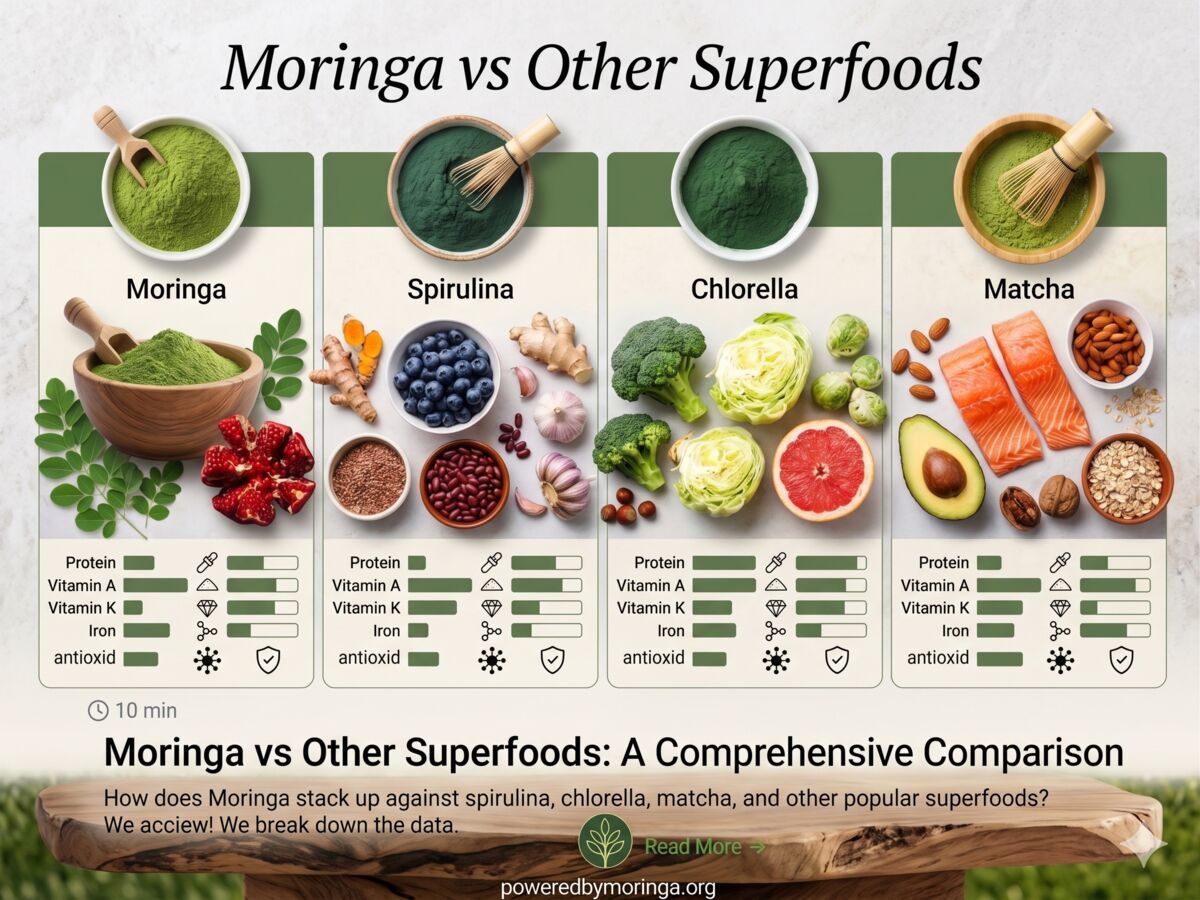
This page is the hub for our comparison articles. It explains the criteria worth comparing on, tells you when each individual comparison is worth reading, and links you to the detailed article. It deliberately does not repeat those articles in full.
The Five Criteria That Actually Matter
1. Nutrient profile per realistic serving. Almost every superfood comparison you'll read online compares 100-gram figures. Nobody eats 100 grams of spirulina or Moringa powder. A typical serving is 3–7 grams. Any comparison that doesn't scale to a real serving is a comparison of laboratory numbers, not of foods.
2. Whether the comparison is like-for-like. Dried powder vs. fresh vegetable is not a fair fight — drying removes water, which concentrates everything per gram, and simultaneously destroys some heat- and light-sensitive nutrients. This is where the "Moringa has 25× the iron of spinach" style claims come from, and it is why we don't use them.
3. Strength of the human evidence. Some of these foods have meta-analyses of randomised controlled trials behind specific claims. Others have mostly cell and animal work. That difference matters far more than a nutrient table.
4. What it's actually for. Caffeine and L-theanine (matcha) do something completely different from protein density (spirulina), which is different again from broad micronutrient contribution (Moringa). These aren't competing products; they're answers to different questions.
5. Sourcing and processing. For every item on this list, how it was grown, harvested and dried changes what's in the finished powder. A carefully processed budget product can easily beat a carelessly processed premium one. We cover this in depth in Why Harvest Timing Changes Everything.
The Individual Comparisons
Moringa vs. Spirulina — read this if you're comparing on protein
Spirulina is one of the most protein-dense foods available: USDA FoodData Central lists dried spirulina at roughly 57 g of protein per 100 g [1]. Dried Moringa leaf powder sits around 25–30 g per 100 g [2]. On protein density, spirulina is clearly ahead, and we're not going to pretend otherwise.
Spirulina also has the stronger human trial record for one specific outcome: meta-analyses of randomised controlled trials report improvements in blood lipid measures with supplementation [3][4]. Moringa does not currently have evidence of that quality behind an equivalent claim.
Where the two genuinely differ is in kind, not rank. Spirulina is a cyanobacterium grown in water tanks; Moringa is a terrestrial tree whose leaves, pods and seeds are also eaten as ordinary food across South Asia and Africa. If you want the detail — including the amino acid and micronutrient comparison — read [Moringa vs. Spirulina](/blog/moringa-vs-spirulina).
Moringa vs. Chlorella — read this if you've heard about "detox"
Chlorella's reputation rests almost entirely on its ability to bind heavy metals. There is real research here, but it is mostly laboratory and environmental work (chlorella is genuinely used in water remediation), with a small number of small human studies [5]. It is not the settled science that supplement marketing implies.
Moringa's liver-related research is a separate story with its own limitations — largely animal models, which we go through honestly in Does Moringa Protect Your Liver?.
Neither food is a detox protocol. Your liver and kidneys are. Full comparison: [Moringa vs. Chlorella](/blog/moringa-vs-chlorella).
Moringa vs. Matcha — read this if you're comparing on energy
This is the cleanest comparison of the four, because the mechanism is different rather than merely graded. Matcha contains caffeine — reported figures vary widely with cultivar, shading and harvest, but a typical serving delivers a meaningful dose [6] — plus L-theanine, which is why matcha's stimulation is often described as smoother than coffee's.
Moringa contains no caffeine. Whatever it contributes to how you feel comes from nutrition, not stimulation, which means it also won't do what caffeine does. If you want alertness in twenty minutes, that's matcha. Full comparison: [Moringa vs. Matcha](/blog/moringa-vs-matcha).
Moringa vs. leafy greens like kale and spinach
We get asked this constantly, and it's the comparison most abused by marketing. The honest answer: dried Moringa leaf powder is more nutrient-dense per gram than fresh kale or spinach, because it's dried and they aren't. Scale both to a realistic serving — a teaspoon of powder vs. a bowl of greens — and the gap narrows dramatically, and in some nutrients reverses.
Moringa is a genuinely useful concentrated contribution to a diet. It is not a replacement for eating vegetables, and any source telling you otherwise is selling something.
So Where Does Moringa Actually Stand?
Fairly, and without the inflation:
- It is not the highest-protein option. Spirulina is.
- It does not have the strongest human clinical evidence base of the group for a specific measurable outcome. Spirulina's lipid data is better.
- It does not do what caffeine does. Matcha does.
- What it does offer is unusually broad micronutrient contribution from a plant that is also an ordinary food crop, a long history of culinary use, and — in whole-plant form — leaves, pods and seeds rather than a single isolated fraction [2].
That's a real case. It doesn't need a "25× more iron than spinach" headline on top of it.
Choosing Between Them
- Protein density is the goal → spirulina
- Fast, smooth alertness is the goal → matcha
- You're specifically interested in the heavy-metal literature → read the chlorella evidence carefully first
- Broad daily nutritional contribution from a whole food → Moringa
- You eat few vegetables → fix that first; no powder substitutes for it
There is also no rule saying you must pick one.
Scientific References
1. U.S. Department of Agriculture, Agricultural Research Service. FoodData Central: Seaweed, spirulina, dried (FDC ID 170495). Reference composition database. USDA FoodData Central
2. Leone A, Spada A, Battezzati A, et al. Cultivation, Genetic, Ethnopharmacology, Phytochemistry and Pharmacology of Moringa oleifera Leaves: An Overview. Int J Mol Sci. 2015;16(6):12791-12835. Compositional review. PubMed
3. The effect of Spirulina supplementation on lipid profile: GRADE-assessed systematic review and dose-response meta-analysis of data from randomized controlled trials. Pharmacol Res. 2023;193:106802. Meta-analysis of human RCTs. PubMed
4. Serban MC, et al. A systematic review and meta-analysis of the impact of Spirulina supplementation on plasma lipid concentrations. Clin Nutr. 2016;35(4):842-51. Meta-analysis of human RCTs. PubMed
5. Merino JJ, et al. The Long-Term Algae Extract (Chlorella and Fucus sp) and Aminosulphurate Supplementation Modulate SOD-1 Activity and Decrease Heavy Metals Levels in Patients with Long-Term Dental Titanium Implants and Amalgam Fillings Restorations. Antioxidants (Basel). 2019;8(4):101. Small human study of a combined supplement. PubMed
6. Matcha Green Tea: Chemical Composition, Phenolic Acids, Caffeine and Fatty Acid Profile. Foods. 2024;13(8). Compositional analysis. PubMed
This article is for educational purposes only and does not constitute medical advice. Comparisons describe nutritional composition and published research; they are not claims that any food prevents, treats or cures disease. Read more about [how we assess evidence](/editorial-standards).
About the Formulator
Vital 1 by CoLab was formulated by Joshua Plant, PhD, a biomedical scientist with a Harvard doctorate and over 13 years of expertise in botanical formulation and nutritional science. His work focused on whole-plant sourcing, evidence-based ingredient selection, and shade-dried processing to preserve the full spectrum of nutrients.
Learn more about Joshua Plant, PhD and the science behind Vital 1Not All Moringa Is the Same — and That's the Point
Vital 1 by CoLab was built around every differentiator covered in this article: India-sourced, shade-dried, whole-plant (leaves, seeds, and fruit), and third-party tested. The comparison speaks for itself.
Now available. Connect with a Wellness Guide to get started and unlock exclusive offers.
🎁 Connect with a Wellness Guide to unlock exclusive offers and member-only perks.
Get StartedWhere would you like to go from here?
No pressure — just a few ways to take the next step, whenever you're ready.
Explore the research
Dig into what the studies actually show about moringa across different areas of health.
Read the benefitsTry it yourselfMake it part of your day
See Vital 1 — whole-plant moringa with 8 supporting botanicals — and how to get started.
Discover Vital 1Share it forwardHelp others learn too
If moringa has helped you, there is a calm way to share it with others — on your terms.
Explore the path