Two Green Powders, Two Very Different Plants
Walk into any health food store and you'll find both moringa powder and matcha sitting on the same "superfood" shelf. Both are green. Both have devoted followings. Both get called "ancient" and "powerful."
But they're fundamentally different plants, with different nutritional profiles, different effects on the body, and different ideal use cases. Treating them as interchangeable does a disservice to both.
This article is for the specific question "which of these should I drink in the morning — do I want caffeine or not?" For the broader picture across all the green powders, start with our hub: Moringa vs Other Superfoods: How to Compare Them Honestly.
What They Actually Are
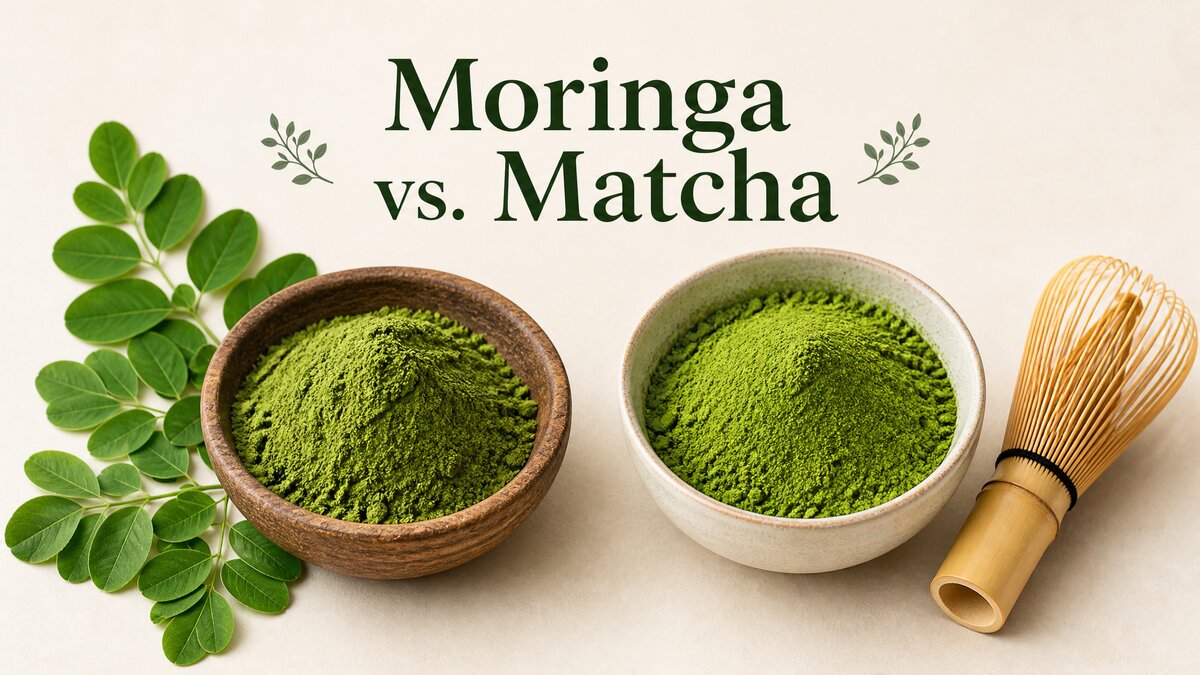
Matcha is finely ground, shade-grown green tea leaves (Camellia sinensis) — the same plant species used for all tea, prepared in a specific way that involves shading the plants before harvest and grinding the whole leaf into powder rather than steeping and discarding it.
Moringa is the dried, ground leaf of the Moringa oleifera tree — a fast-growing tree native to the Indian subcontinent, unrelated to tea in any way.
They're both green powders. That's roughly where the similarity ends.
Caffeine: The Biggest Practical Difference
This is the difference that matters most for most people.
Matcha contains caffeine. Published figures vary widely — caffeine content depends on cultivar, how long the plants were shaded, harvest timing and how much powder you use — but a typical 1.5–4 g serving delivers a meaningful dose, broadly comparable to a cup of tea or a light coffee [1][2]. Be sceptical of any source quoting a single precise number; the analytical literature doesn't support that level of precision. Matcha also contains L-theanine, an amino acid thought to moderate caffeine's effects, which is the usual explanation for the smoother energy matcha drinkers describe [1].
Moringa contains no caffeine at all. Any energy-related benefits come from a different mechanism entirely — supporting the nutritional building blocks the body uses to produce energy at a cellular level (B vitamins, iron, amino acids), rather than stimulating the nervous system directly.
This single difference determines a lot about who should reach for which:
- Want an alternative to coffee with a smoother caffeine effect? Matcha is built for that.
- Want nutritional support without any stimulant effect — including at night, or for caffeine-sensitive individuals? Moringa fits that role.
- Pregnant, breastfeeding, or caffeine-restricted? Moringa is the caffeine-free choice between the two.
Nutritional Profile Comparison
Matcha's strengths: Matcha is rich in catechins — particularly EGCG (epigallocatechin gallate), the most studied antioxidant compound in green tea [1]. Because you consume the whole ground leaf rather than an infusion, matcha delivers substantially more catechin per serving than steeped green tea [2]. Worth noting: much of the EGCG research is laboratory and animal work, and reviewers consistently call for more human trials before drawing firm health conclusions [1].
Moringa's strengths: All nine essential amino acids, which is unusual for a leaf, plus iron, calcium, provitamin A and vitamin C, and a different antioxidant class — flavonoids such as quercetin and kaempferol, phenolic acids, and isothiocyanates [3]. Moringa's own human evidence base has real quality limitations too, which we don't hide from [4].
Neither is "more nutritious" in an absolute sense — they provide different nutrients, in different categories, for different purposes.
Taste and Usability
Matcha has a distinct, somewhat bitter, umami-forward flavor that many people enjoy on its own, traditionally whisked with hot water, or blended into lattes.
Moringa has a more neutral, mildly earthy, slightly grassy taste — often described as easier to mask in smoothies, juices, or flavored products than matcha's more assertive flavor profile. This is part of why moringa is frequently formulated into flavored stick-packs or blends rather than consumed plain.
Which One Should You Choose?
This isn't really an either/or decision — many people use both, for different purposes.
Choose matcha if: you want a smoother alternative to coffee, enjoy the ritual of preparing it, and don't mind or actively want a moderate amount of caffeine.
Choose moringa if: you want whole-food nutritional support without any caffeine, you're sensitive to stimulants, or you're looking for nutrient density (amino acids, iron, vitamins) rather than a specific antioxidant compound.
Use both if: you want matcha for your morning ritual and caffeine, and moringa as a separate, caffeine-free nutritional foundation later in the day or paired with a different routine.
They're not competitors so much as two different tools for two different jobs.
The Bottom Line
Matcha and moringa get lumped together because they're both green and both trendy, but they serve genuinely different purposes. Matcha is a caffeinated, antioxidant-rich tea product with a long ceremonial history. Moringa is a caffeine-free, whole-plant nutritional source with a different and broader nutrient profile.
The right choice depends on what you're actually looking for — a coffee alternative, or a daily nutritional foundation.
Scientific References
1. Kochman J, Jakubczyk K, Antoniewicz J, et al. Health Benefits and Chemical Composition of Matcha Green Tea: A Review. Molecules. 2020;26(1):85. Composition and evidence review. PubMed
2. Weiss DJ, Anderton CR. Determination of catechins in matcha green tea by micellar electrokinetic chromatography. J Chromatogr A. 2003;1011(1-2):173-80. Analytical chemistry study. PubMed
3. Leone A, Spada A, Battezzati A, et al. Cultivation, Genetic, Ethnopharmacology, Phytochemistry and Pharmacology of Moringa oleifera Leaves: An Overview. Int J Mol Sci. 2015;16(6):12791-12835. Compositional review. PubMed
4. Health effects of Moringa oleifera: an umbrella review of systematic reviews and meta-analyses. Front Pharmacol. 2025;16:1572337. Umbrella review. Frontiers
This article is for educational purposes only and does not constitute medical advice. Read more about [how we assess evidence](/editorial-standards).
About the Formulator
Vital 1 by CoLab was formulated by Joshua Plant, PhD, a biomedical scientist with a Harvard doctorate and over 13 years of expertise in botanical formulation and nutritional science. His work focused on whole-plant sourcing, evidence-based ingredient selection, and shade-dried processing to preserve the full spectrum of nutrients.
Learn more about Joshua Plant, PhD and the science behind Vital 1If You're Looking for the Moringa Side of This Equation
Vital 1 by CoLab uses whole-plant, India-sourced, shade-dried Moringa — combined with a botanical blend designed to support energy and overall nutrition, without any caffeine or stimulant effect.
Now available. Connect with a Wellness Guide to get started and unlock exclusive offers.
🎁 Connect with a Wellness Guide to unlock exclusive offers and member-only perks.
Get StartedWhere would you like to go from here?
No pressure — just a few ways to take the next step, whenever you're ready.
Explore the research
Dig into what the studies actually show about moringa across different areas of health.
Read the benefitsTry it yourselfMake it part of your day
See Vital 1 — whole-plant moringa with 8 supporting botanicals — and how to get started.
Discover Vital 1Share it forwardHelp others learn too
If moringa has helped you, there is a calm way to share it with others — on your terms.
Explore the path