By the Powered By Moringa Editorial Team
If you're new to moringa, the amount of information out there can feel overwhelming — dosage charts, miracle-cure claims, a dozen different forms to choose from. This guide strips that back to the practical basics: what moringa actually is, how to start taking it, what to expect, and what to look for in a quality product.
Quick Takeaways
- Moringa leaf powder is the most-studied and most beginner-friendly form
- Most people start with about ½ teaspoon (roughly 1 gram) daily and build up gradually
- Typical daily amounts in human studies range from about 1 to 6 grams, though some research has used more
- Mild digestive adjustment in the first week or two is common and usually temporary
- Whole-leaf, third-party tested products are the safer choice over root, bark, or unlabeled blends
- Anyone pregnant, breastfeeding, or on medication should talk to a doctor before starting
What Moringa Actually Is
Moringa oleifera is a fast-growing tree native to parts of Asia and Africa, sometimes called the drumstick tree. Its leaves have been eaten as a vegetable and used in traditional cooking for generations, long before "superfood" became a marketing term. Modern supplements are typically made from the leaf, dried and ground into a powder, though some products use the seed or other plant parts. Most of the human research on moringa — including everything we've covered in our other articles on this site — has focused specifically on the leaf, which is worth knowing since different parts of the plant behave differently in the body.
Choosing a Form: Powder, Capsules, or Tea
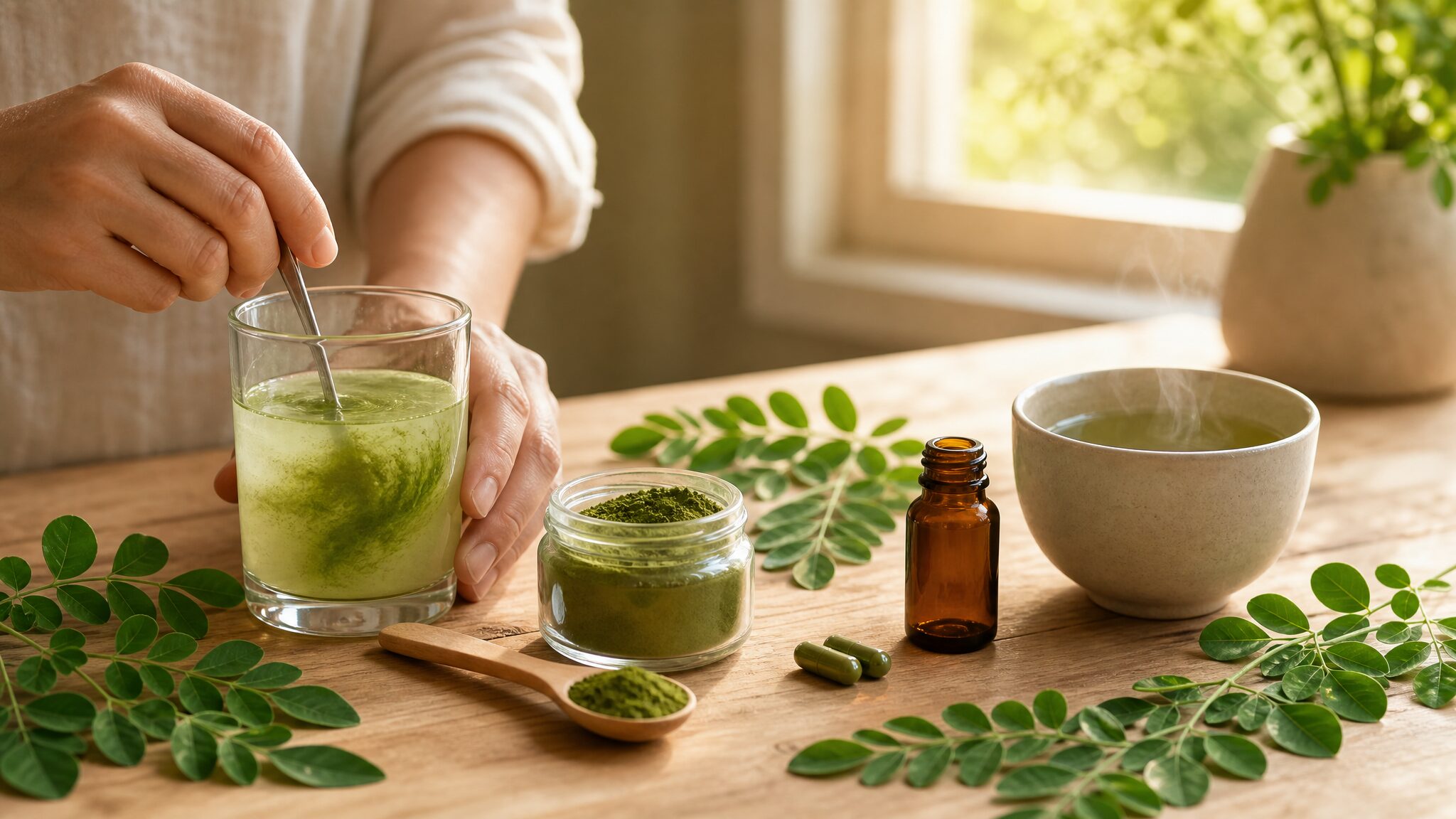
There's no single "best" form — it depends on your routine and preferences. What matters more is consistency and starting at a reasonable dose. Here's how the three most common options compare.
| Form | Best For | What to Know |
|---|---|---|
| Powder | Flexibility and gradual dosing | Most versatile and widely studied; stir into smoothies, yogurt, oatmeal, or soups. Earthy, slightly bitter flavor — easier mixed into other foods than plain water. |
| Capsules | Convenience and consistency | Tasteless, pre-measured dose; great while you're still getting used to moringa, but harder to adjust in small increments. |
| Tea | Easing in slowly | Gentler, lower concentration per serving than powder or capsules; a reasonable starting point for a slow introduction. |
The flavor of the powder is earthy and slightly bitter, similar to matcha or strong green tea — most people find it easier to tolerate mixed into something with other flavors rather than taken in plain water.
How Much to Take When You're Starting Out
A practical starting point is about ½ teaspoon (roughly 1 gram) of moringa leaf powder daily, taken with food. After several days without issues, many people gradually increase toward a maintenance range of about 1 to 2 teaspoons (roughly 3 to 6 grams) daily. Human research on moringa has generally used doses in the range of 1 to 8 grams per day, depending on the study and its goals, so this beginner range is well within what's been studied.
| Phase | Approximate Amount | Notes |
|---|---|---|
| Days 1–5 | ~½ tsp (≈1 g) daily | Take with food to minimize digestive adjustment |
| Week 2 onward | ~1 tsp (≈3 g) daily | Increase only if well tolerated |
| Maintenance | ~1–2 tsp (≈3–6 g) daily | Within the range used in most human studies |
There's no officially established upper limit, but going well beyond typical study doses hasn't shown added benefit and increases the likelihood of digestive discomfort.
More is not automatically better here — consistency at a moderate dose matters more than maximizing the amount.
What to Expect in the First Couple of Weeks
Some people notice mild digestive effects when they first start — loose stools, mild bloating, or an upset stomach — particularly if they start with too much too quickly or take it on an empty stomach. This is usually temporary and tends to resolve within one to two weeks as your body adjusts. Starting low, increasing gradually, and taking moringa with food are the simplest ways to avoid this altogether.
If digestive discomfort is significant or persists beyond a couple of weeks, that's a signal to scale back or stop and check in with a healthcare provider, rather than push through it.
What to Look For in a Quality Product
Because moringa is sold as a dietary supplement rather than a regulated medication, product quality varies meaningfully between brands. A few things are worth checking before you buy:
Look for products that clearly specify moringa leaf as the plant part used, rather than a vague "moringa blend" that could include root, bark, or other parts with a different safety profile. Third-party lab testing is a meaningful signal of quality, since it verifies potency and screens for contaminants like heavy metals or pesticides. How the leaf is processed also matters — shade-dried leaf preserves more of the plant's original nutrient profile than leaf exposed to prolonged heat or direct sun during drying. And sourcing transparency, including where and how the plant was grown, is a reasonable thing to expect from any brand asking you to trust what's in the product.
Who Should Talk to a Doctor First
Moringa is generally well tolerated by healthy adults at moderate doses, but a few groups should check with a healthcare provider before starting: anyone who is pregnant or breastfeeding, anyone taking medication for blood sugar, blood pressure, thyroid function, or blood clotting, and anyone managing a chronic liver or kidney condition. This isn't because moringa is inherently dangerous — it's because it's biologically active enough to interact with some medications and conditions, and a quick conversation with a doctor is a small step that removes any guesswork.
Frequently Asked Questions
How much moringa should a beginner take?
Start with about ½ teaspoon (roughly 1 gram) of leaf powder daily with food, and increase gradually over one to two weeks if it's well tolerated.
What does moringa taste like?
Earthy and slightly bitter, often compared to matcha or strong green tea. Mixing it into a smoothie, yogurt, or oatmeal makes it easier to tolerate than taking it in plain water.
Is moringa powder or capsules better for beginners?
Powder is more versatile and easier to dose gradually; capsules are more convenient and consistent but harder to adjust in small increments. Either is a reasonable starting point.
Is moringa safe to take every day?
Human studies lasting several weeks to months have generally found moringa leaf well tolerated at moderate daily doses, though anyone with a medical condition or on medication should confirm with a doctor first.
Want to go deeper? Learn more about what moringa is, understand why the whole plant matters, read our broader breakdown of moringa's benefits, or check the primary research yourself on our references page.
Scientific References
1. Stohs SJ, Hartman MJ. Review of the Safety and Efficacy of Moringa oleifera. Phytother Res. 2015;29(6):796-804. Review of human and animal safety data, including dosage ranges used in clinical studies. PubMed
2. Leone A, Spada A, Battezzati A, et al. Cultivation, Genetic, Ethnopharmacology, Phytochemistry and Pharmacology of Moringa oleifera Leaves: An Overview. Int J Mol Sci. 2015;16(6):12791-12835. Comprehensive review covering nutritional composition, amino acid profile, and traditional uses. PubMed
3. Anwar F, Latif S, Ashraf M, Gilani AH. Moringa oleifera: a food plant with multiple medicinal uses. Phytother Res. 2007;21(1):17-25. Review of moringa's nutritional value and documented medicinal applications. PubMed
These references support the general claims made in this article. For our full evidence-review methodology, see [how we assess evidence](/editorial-standards).
This article is for educational purposes and is not medical advice. Speak with a qualified healthcare provider before starting any new supplement, particularly if you are pregnant, breastfeeding, or taking medication.
About the Formulator
Vital 1 by CoLab was formulated by Joshua Plant, PhD, a biomedical scientist with a Harvard doctorate and over 13 years of expertise in botanical formulation and nutritional science. His work focused on whole-plant sourcing, evidence-based ingredient selection, and shade-dried processing to preserve the full spectrum of nutrients.
Learn more about Joshua Plant, PhD and the science behind Vital 1Ready to Start With a Whole-Plant Moringa You Can Actually Enjoy?
Vital 1 by CoLab uses whole-plant, India-sourced, shade-dried Moringa as its foundation — the same whole-leaf form used in most of the human research, in a flavor designed to actually be enjoyable.
Now available. Connect with a Wellness Guide to get started and unlock exclusive offers.
🎁 Connect with a Wellness Guide to unlock exclusive offers and member-only perks.
Get StartedWhere would you like to go from here?
No pressure — just a few ways to take the next step, whenever you're ready.
Explore the research
Dig into what the studies actually show about moringa across different areas of health.
Read the benefitsTry it yourselfMake it part of your day
See Vital 1 — whole-plant moringa with 8 supporting botanicals — and how to get started.
Discover Vital 1Share it forwardHelp others learn too
If moringa has helped you, there is a calm way to share it with others — on your terms.
Explore the path